

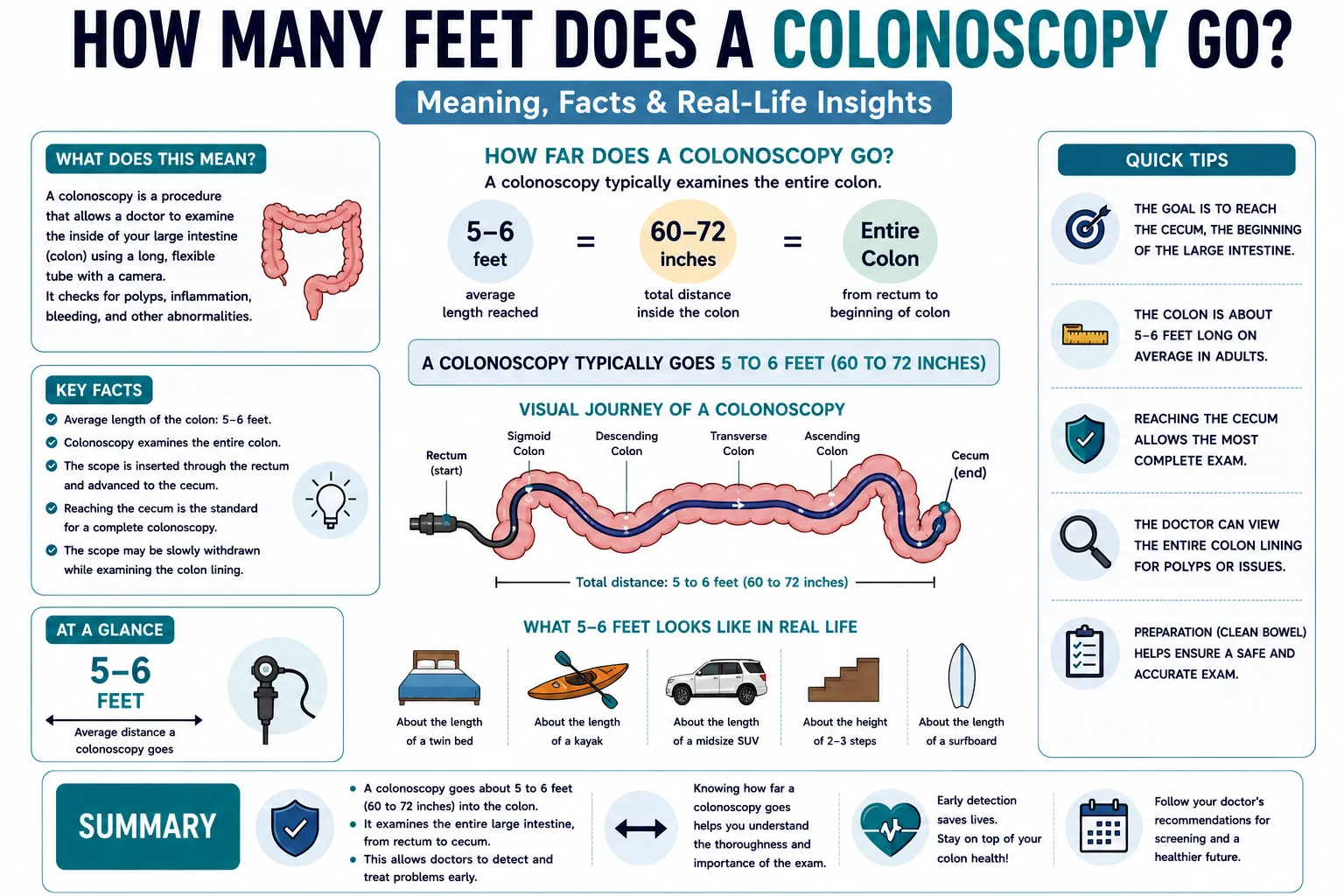
If you’re preparing for a colonoscopy, one question you may have is: how many feet does a colonoscopy go?
The short answer is that a colonoscopy typically examines about 5 to 6 feet of the large intestine (colon). During the procedure, a flexible instrument called a colonoscope is carefully guided through the rectum and advanced through the entire colon, often reaching the beginning of the large intestine known as the cecum.
Understanding how far a colonoscopy goes can help reduce anxiety and provide a clearer picture of what happens during this important screening test.
In this guide, you’ll learn how many feet a colonoscopy covers, what parts of the digestive tract are examined, why the procedure is performed, and what to expect before, during, and after the exam.
Quick Answer: How Many Feet Does a Colonoscopy Go?
A standard colonoscopy typically examines:
- Approximately 5 to 6 feet of the large intestine
- The entire colon from the rectum to the cecum
- Sometimes a small portion of the terminal ileum (the end of the small intestine)
The average adult colon measures about:
- 4.5 to 6 feet long
- Roughly 150 centimeters in length
In most successful procedures, doctors aim to inspect the entire colon.
What Is a Colonoscopy?
A colonoscopy is a medical procedure used to examine the inside of the large intestine.
Doctors use a thin, flexible tube called a colonoscope that contains:
- A camera
- A light source
- Specialized instruments if needed
The camera sends images to a monitor, allowing the doctor to inspect the lining of the colon.
Purpose of a Colonoscopy
A colonoscopy may be recommended to:
- Screen for colon cancer
- Investigate rectal bleeding
- Evaluate chronic diarrhea
- Check unexplained abdominal pain
- Monitor inflammatory bowel disease
- Remove polyps
- Investigate changes in bowel habits
How a Colonoscope Works
The colonoscope is gently inserted through the rectum and advanced through the colon.
Air or carbon dioxide is used to expand the colon slightly, improving visibility.
The physician carefully examines the intestinal lining while advancing and withdrawing the scope.
How Many Feet Does a Colonoscopy Go Inside the Body?
The exact distance depends on a person’s anatomy.
However, in most adults, the colonoscope travels approximately:
| Structure | Approximate Length |
|---|---|
| Rectum | 5–6 inches |
| Sigmoid Colon | 15–20 inches |
| Descending Colon | 10–12 inches |
| Transverse Colon | 18–24 inches |
| Ascending Colon | 8–10 inches |
| Cecum | Starting point of the colon |
Combined, these sections total approximately:
- 5 to 6 feet
This means the answer to how many feet does a colonoscopy go is generally the full length of the colon.
Average Length Examined
Most gastroenterologists aim to reach:
- The cecum
- Sometimes the terminal ileum
Reaching these areas confirms a complete colonoscopy.
Understanding Colon Anatomy
The colon is the final section of the digestive tract.
Its primary functions include:
- Absorbing water
- Forming stool
- Storing waste before elimination
Because diseases can develop anywhere in the colon, examining the entire length is important.
Parts of the Colon Examined During a Colonoscopy
A complete colonoscopy evaluates several sections.
Rectum
The rectum is the final part of the digestive system before the anus.
Doctors examine it for:
- Hemorrhoids
- Polyps
- Tumors
- Inflammation
Sigmoid Colon
This S-shaped portion often develops:
- Diverticulosis
- Polyps
- Early cancerous growths
Descending Colon
The descending colon runs down the left side of the abdomen.
Doctors inspect it for abnormalities and inflammation.
Transverse Colon
This is the longest section of the colon.
It stretches across the upper abdomen.
Ascending Colon
The ascending colon travels upward along the right side of the abdomen.
Certain cancers develop in this area without causing early symptoms.
Cecum
The cecum marks the beginning of the large intestine.
Reaching this point confirms a complete examination.
Why Doctors Examine the Entire Colon
Examining only part of the colon could miss important findings.
A full colonoscopy helps detect:
- Colon polyps
- Colorectal cancer
- Ulcerative colitis
- Crohn’s disease
- Diverticular disease
- Internal bleeding sources
Many colon cancers begin as small polyps.
Finding and removing these growths early can significantly reduce cancer risk.
How Long Is the Human Colon?
The human colon varies slightly in length from person to person.
Here is a general comparison:
| Measurement | Approximate Length |
|---|---|
| Adult Colon | 4.5–6 feet |
| Average Height Adult | 5–6 feet |
| Small Intestine | 15–20 feet |
Although the small intestine is much longer, a standard colonoscopy focuses primarily on the large intestine.
Colon Length Comparison Chart
| Organ | Approximate Length |
|---|---|
| Esophagus | 10 inches |
| Stomach | 10–12 inches |
| Small Intestine | 15–20 feet |
| Colon | 5–6 feet |
This comparison helps illustrate why a colonoscope must travel a considerable distance during the procedure.
What Happens During a Colonoscopy?
Many patients feel nervous before their first colonoscopy.
Knowing the process often helps reduce anxiety.
Before the Procedure
Preparation usually involves:
- A clear liquid diet
- Laxatives
- Colon cleansing solution
- Avoiding certain foods
A clean colon allows doctors to see abnormalities clearly.
During the Procedure
The procedure typically lasts:
- 20 to 60 minutes
Patients often receive sedation to improve comfort.
During the exam:
- The colonoscope is inserted through the rectum
- The scope advances through the colon
- Images are viewed on a monitor
- Polyps may be removed if found
After the Procedure
Most people:
- Rest briefly
- Go home the same day
- Resume normal activities within 24 hours
Some temporary bloating or gas is common.
Common Findings During a Colonoscopy
A colonoscopy may reveal:
Colon Polyps
These are small growths that can sometimes become cancerous.
Diverticulosis
Small pouches can develop in the colon wall.
Inflammation
Doctors may identify:
- Ulcerative colitis
- Crohn’s disease
- Infectious colitis
Hemorrhoids
Internal hemorrhoids may be visible during examination.
Colorectal Cancer
Early detection greatly improves treatment outcomes.
Benefits and Risks of Colonoscopy
Like any medical procedure, colonoscopy has advantages and potential risks.
Benefits
- Detects colon cancer early
- Removes polyps before they become cancerous
- Investigates digestive symptoms
- Provides detailed visualization
- Helps prevent colorectal cancer
Potential Risks
Although uncommon, risks may include:
- Bleeding
- Infection
- Reaction to sedation
- Colon perforation
Serious complications are rare when performed by experienced specialists.
Common Misconceptions About Colonoscopy Length
Several myths surround colonoscopy procedures.
Myth: The Scope Only Goes a Short Distance
In reality, a complete colonoscopy typically examines the entire colon.
Myth: The Colonoscope Is Rigid
Modern colonoscopes are flexible and designed to navigate the colon safely.
Myth: A Longer Colonoscopy Means More Pain
Sedation and modern techniques help keep most patients comfortable.
Myth: Colonoscopy Is Only for Older Adults
Younger adults may also need screening based on symptoms, family history, or medical conditions.
Expert Tips Before Your Colonoscopy
To improve your experience:
- Follow preparation instructions carefully
- Drink plenty of approved fluids
- Arrange transportation home
- Ask questions beforehand
- Inform your doctor about medications
Proper preparation is often the most important factor in obtaining accurate results.
Conclusion
So, how many feet does a colonoscopy go?
In most adults, a colonoscopy examines approximately 5 to 6 feet of the large intestine, covering the entire colon from the rectum to the cecum. This allows doctors to inspect the colon lining thoroughly, detect abnormalities, remove polyps, and screen for colorectal cancer.
Although many people feel nervous before the procedure, colonoscopy remains one of the most effective tools for protecting long-term digestive health. Understanding how far the scope travels and what happens during the exam can make the process feel much less intimidating.
FAQs
How many feet does a colonoscopy go into the body?
A complete colonoscopy usually examines about 5 to 6 feet of the large intestine.
Does a colonoscopy examine the entire colon?
Yes. Doctors generally aim to inspect the entire colon from the rectum to the cecum.
Can a colonoscopy reach the small intestine?
Sometimes. The scope may enter a short section of the terminal ileum, which is the end of the small intestine.
How long does a colonoscopy procedure take?
Most procedures take between 20 and 60 minutes, depending on findings and individual anatomy.
Is a colonoscopy painful?
Most patients receive sedation and experience little to no pain during the procedure. Some mild bloating or cramping afterward is normal.
Discover More
How Many Feet in a Yard of Dirt?
How Many Square Feet for 1 Ton AC?
How Many Square Feet Will 17000 BTU Heat?