

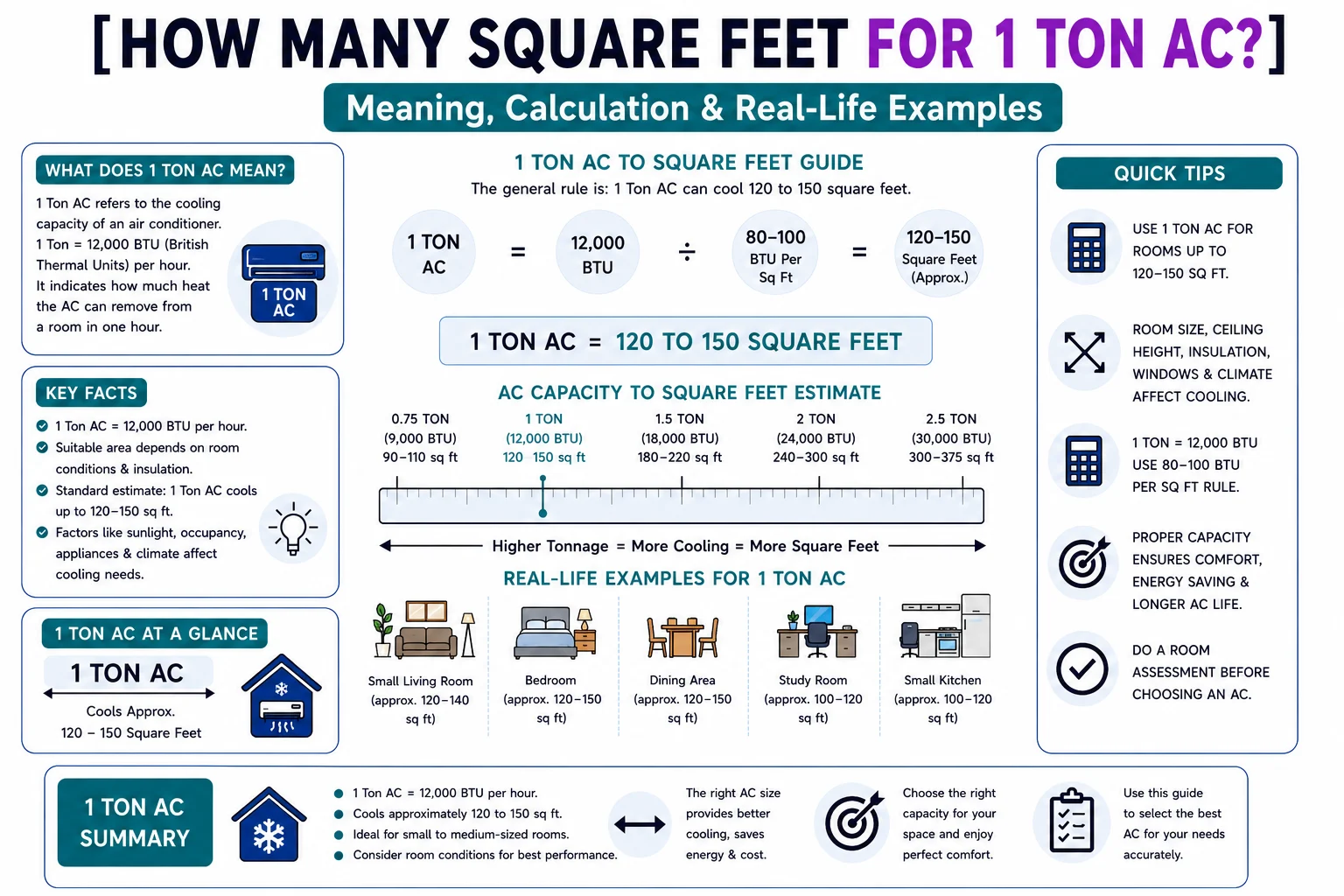
If you are planning to buy an air conditioner, one of the most common questions is: how many square feet for 1 ton AC?
In general, a 1 ton AC can cool around 100 to 150 square feet under normal conditions. However, the actual cooling area depends on several important factors such as insulation, room height, climate, sunlight exposure, and the number of people using the room.
Choosing the right AC size is important for comfort, energy efficiency, and lower electricity bills. A small AC may struggle to cool the room, while an oversized unit can waste power and increase costs.
This guide explains everything you need to know about 1 ton AC coverage, including room size charts, cooling calculations, expert tips, and common mistakes to avoid.
What Does 1 Ton AC Mean?
Many people think “1 ton” refers to the weight of the air conditioner, but that is not correct.
In HVAC terms, 1 ton equals 12,000 BTUs (British Thermal Units) per hour. BTU measures how much heat an AC can remove from a room.
So, a 1 ton AC can remove:
- 12,000 BTUs of heat per hour
The term comes from the amount of energy needed to melt one ton of ice in 24 hours.
Today, AC manufacturers still use “tonnage” to describe cooling capacity.
How Many Square Feet Can a 1 Ton AC Cool?
A standard 1 ton air conditioner usually cools:
| Room Condition | Estimated Coverage |
|---|---|
| Excellent insulation | 150–180 sq ft |
| Average insulation | 100–150 sq ft |
| Poor insulation | 80–120 sq ft |
Most HVAC professionals recommend around:
- 20 BTUs per square foot for average cooling
Since a 1 ton AC provides 12,000 BTUs:
12,000 ÷ 20 = 600 sq ft theoretically
However, real-world residential cooling requirements are different because of humidity, sunlight, appliances, and airflow. That is why most manufacturers recommend a practical range of 100–150 square feet for optimal cooling.
Standard Cooling Coverage
A 1 ton AC is usually suitable for:
- Small bedrooms
- Guest rooms
- Small offices
- Studio apartments
- Small living rooms
It works best in compact spaces with proper insulation and moderate temperatures.
Quick AC Tonnage Chart
| AC Size | Approximate Coverage |
|---|---|
| 0.8 Ton | 80–100 sq ft |
| 1 Ton | 100–150 sq ft |
| 1.5 Ton | 150–250 sq ft |
| 2 Ton | 250–400 sq ft |
| 3 Ton | 400–600 sq ft |
This chart provides general estimates only.
Factors That Affect 1 Ton AC Coverage
Several conditions determine whether a 1 ton AC can cool your room efficiently.
Room Insulation
Good insulation helps keep cool air inside.
Rooms with:
- Double-pane windows
- Insulated walls
- Proper sealing
- Quality roofing
will cool faster and stay comfortable longer.
Poor insulation forces the AC to work harder.
Climate and Temperature
Hot climates require larger AC systems.
For example:
- A 1 ton AC may work perfectly in mild climates
- The same unit may struggle in very hot or humid regions
Cities with extreme summer temperatures usually need more cooling power.
Ceiling Height
Most AC calculations assume an 8-foot ceiling.
Rooms with:
- High ceilings
- Vaulted ceilings
- Open loft designs
contain more air volume and may need a larger AC.
Sunlight Exposure
Rooms that receive direct sunlight heat up faster.
South-facing rooms or rooms with large glass windows often require more cooling capacity.
Using curtains or blinds can improve efficiency.
Number of People and Appliances
Every person and electronic device generates heat.
Extra heat sources include:
- Computers
- TVs
- Refrigerators
- Ovens
- Gaming systems
A crowded room may need a larger AC even if the square footage seems small.
Is a 1 Ton AC Enough for Your Room?
A 1 ton AC works well in the right conditions, but not every room is suitable.
Best Room Types
A 1 ton AC is ideal for:
- Bedrooms under 150 sq ft
- Small apartments
- Home offices
- Study rooms
- Small retail spaces
It performs best when:
- Insulation is good
- Sun exposure is limited
- The room is not overcrowded
When You Need a Bigger AC
You may need a 1.5 ton or 2 ton AC if your room:
- Exceeds 150 sq ft
- Has poor insulation
- Receives heavy sunlight
- Has high ceilings
- Contains many heat-producing appliances
An undersized AC can run continuously without cooling properly.
How to Calculate AC Size for Any Room
You can estimate AC tonnage with a simple calculation.
Basic Formula
A common HVAC estimate is:
Room area × 20 BTUs per square foot
Then divide by 12,000 to convert BTUs into AC tonnage.
Example Calculation
Suppose your room is:
12 feet × 12 feet = 144 sq ft
Cooling requirement:
144 × 20 = 2,880 BTUs
Since 1 ton AC provides 12,000 BTUs, it can easily handle this room under average conditions.
However, adjustments may be needed for:
- Hot climates
- Large windows
- Poor insulation
- Heavy occupancy
1 Ton AC vs Other AC Sizes
Choosing the right AC size is important for comfort and efficiency.
| AC Size | Best For | Cooling Range |
|---|---|---|
| 0.8 Ton | Small rooms | 80–100 sq ft |
| 1 Ton | Bedrooms | 100–150 sq ft |
| 1.5 Ton | Medium rooms | 150–250 sq ft |
| 2 Ton | Large rooms | 250–400 sq ft |
| 3 Ton | Large homes | 400–600 sq ft |
A 1 ton AC is one of the most popular choices because it balances:
- Energy efficiency
- Lower operating costs
- Compact installation
- Affordable pricing
Energy Efficiency Tips for Better Cooling
Even a correctly sized AC can waste energy if the room is inefficient.
Here are practical tips to improve cooling performance.
Keep Filters Clean
Dirty filters reduce airflow and make the AC work harder.
Clean or replace filters regularly.
Use Curtains and Blinds
Blocking direct sunlight helps maintain cooler indoor temperatures.
Seal Air Leaks
Prevent cool air from escaping through:
- Doors
- Windows
- Wall gaps
Use Ceiling Fans
Fans improve air circulation and help rooms feel cooler.
Choose Inverter AC Models
Inverter air conditioners adjust compressor speed automatically, reducing energy use and improving comfort.
Common Mistakes When Choosing AC Size
Many homeowners choose the wrong AC size.
Here are the most common mistakes.
Buying Based Only on Price
Cheaper units may not provide enough cooling.
Always match the AC size to the room.
Ignoring Room Conditions
Sunlight, insulation, and occupancy affect cooling performance.
Oversizing the AC
An oversized AC cools too quickly without removing enough humidity.
This can leave the room feeling damp and uncomfortable.
Forgetting Future Needs
Room usage may change over time.
Adding more electronics or furniture can increase cooling requirements.
Not Consulting HVAC Experts
Professional calculations provide more accurate sizing for difficult spaces.
Conclusion
So, how many square feet for 1 ton AC?
In most homes, a 1 ton AC can effectively cool around 100 to 150 square feet under average conditions. However, the exact coverage depends on factors like insulation, climate, ceiling height, sunlight, and room occupancy.
Before choosing an air conditioner, always consider:
- Room size
- Heat exposure
- Ceiling height
- Number of occupants
- Energy efficiency
A properly sized AC improves comfort, lowers electricity bills, and extends the life of the system.
If you are unsure about sizing, consulting an HVAC professional can help you choose the best air conditioner for your specific space.
FAQs
How many square feet does a 1 ton AC cover?
A 1 ton AC generally covers about 100–150 square feet in average conditions.
Is 1 ton AC enough for a bedroom?
Yes. A 1 ton AC is usually ideal for small to medium bedrooms with normal insulation.
Can a 1 ton AC cool a living room?
It depends on the size. Small living rooms under 150 sq ft may work well with a 1 ton AC.
Does ceiling height affect AC tonnage?
Yes. Higher ceilings increase room volume and may require a larger AC.
What happens if my AC is too small?
A small AC may:
- Run continuously
- Increase electricity bills
- Cool unevenly
- Wear out faster
Discover More
how many square feet in 10 by 10 room