

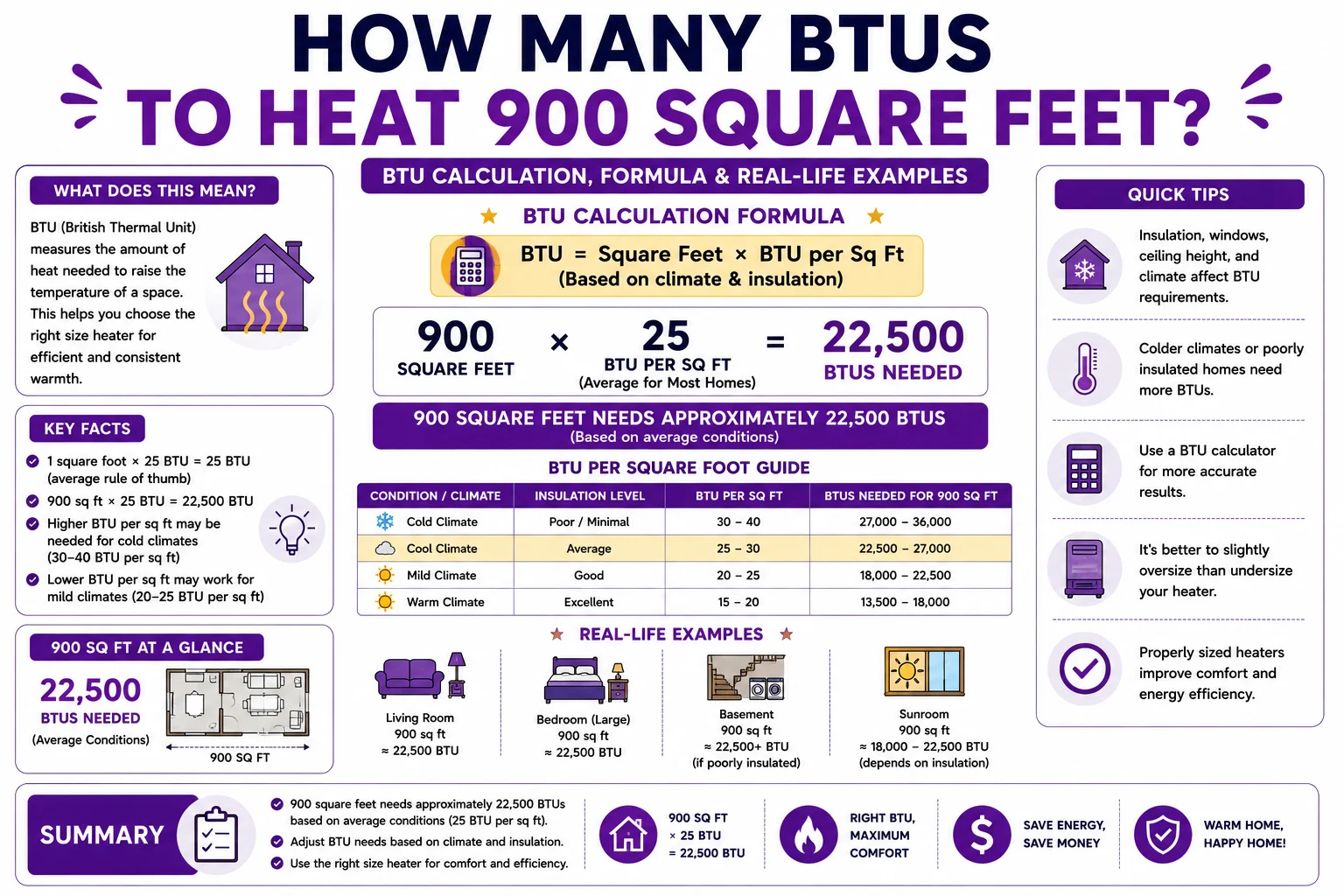
If you’re shopping for a heater or furnace, you may be asking:
how many BTUs to heat 900 square feet?
Choosing the right BTU size is extremely important. A heater that’s too small may struggle to keep your space warm, while an oversized unit can waste energy and increase utility bills.
Here’s the quick answer:
👉 Most 900-square-foot spaces need 18,000 to 27,000 BTUs for effective heating.
However, the exact number depends on:
- Climate
- Insulation
- Ceiling height
- Window size
- Home layout
In this guide, you’ll learn:
- What BTUs mean
- Exact heating estimates for 900 sq ft
- BTU formulas
- Heating charts
- Common sizing mistakes
- Energy-saving tips
Quick Answer: BTUs Needed for 900 Square Feet
A general rule is:
👉 You need about 20–30 BTUs per square foot for heating.
For 900 square feet:
900×20=18,000
to
900×30=27,000
So:
👉 18,000–27,000 BTUs is the typical range.
What Is a BTU?
BTU stands for:
👉 British Thermal Unit
It measures how much heat a heating system can produce.
In simple terms:
- Higher BTUs = more heating power
- Lower BTUs = less heating power
BTUs help determine whether a heater can efficiently warm a room or house.
How Many BTUs to Heat 900 Square Feet Exactly
The exact BTU requirement changes depending on climate and home efficiency.
Mild Climate Estimate
If you live in a warmer area with mild winters:
- 18,000–20,000 BTUs may be enough
Examples:
- Southern states
- Warm coastal regions
Moderate Climate Estimate
For average winter conditions:
- 20,000–24,000 BTUs is common
This works well for:
- Standard apartments
- Average insulation
Cold Climate Estimate
In colder regions:
- 24,000–27,000 BTUs may be needed
Especially if:
- Winters are harsh
- Insulation is poor
- Ceilings are high
BTU Heating Formula Explained
A basic heating formula is:
BTUs Needed=Square Feet×BTUs Per Square Foot
For a 900-square-foot space:
900×25=22,500
That means a mid-range estimate is around:
👉 22,500 BTUs
Factors That Affect Heating Needs
Several things impact how many BTUs you actually need.
Climate
Colder climates require more heating power.
- Mild climates = fewer BTUs
- Cold climates = higher BTUs
Insulation
Well-insulated homes hold heat better.
Good insulation can lower BTU requirements significantly.
Ceiling Height
Higher ceilings create more air volume.
Rooms with vaulted ceilings usually need more BTUs.
Windows and Doors
Drafty windows allow heat loss.
Large windows may increase heating needs.
BTU Chart by Square Footage
Here’s a helpful reference chart:
| Square Feet | Recommended BTUs |
|---|---|
| 300 sq ft | 6,000–9,000 |
| 500 sq ft | 10,000–15,000 |
| 700 sq ft | 14,000–21,000 |
| 900 sq ft | 18,000–27,000 |
| 1,200 sq ft | 24,000–36,000 |
| 1,500 sq ft | 30,000–45,000 |
Best Heating Systems for 900 Square Feet
Different heating systems work well for this space size.
Space Heaters
Best for:
- Single rooms
- Apartments
- Supplemental heating
Furnaces
Ideal for:
- Whole-home heating
- Consistent warmth
Mini-Split Systems
Great for:
- Energy efficiency
- Zoned heating
Electric Baseboard Heaters
Useful for:
- Smaller homes
- Easy installation
Common BTU Sizing Mistakes
Many homeowners choose the wrong heater size.
Choosing Too Small
Undersized heaters:
- Run constantly
- Struggle to heat space
- Increase wear and tear
Choosing Too Large
Oversized units:
- Waste energy
- Heat unevenly
- Cycle on and off too often
Ignoring Insulation
A well-insulated home needs fewer BTUs.
Forgetting Ceiling Height
Tall ceilings require additional heating power.
Energy Efficiency Tips
Want lower heating costs? Follow these tips.
Improve Insulation
Seal drafts around:
- Doors
- Windows
- Attics
Use Smart Thermostats
Smart thermostats help control energy usage.
Maintain Your Heating System
Regular maintenance improves efficiency.
Close Unused Rooms
This helps focus heat where needed.
How to Choose the Right Heater
Before buying a heater:
- Measure square footage accurately
- Consider local climate
- Check insulation quality
- Compare energy efficiency ratings
- Read BTU specifications carefully
If unsure, consult an HVAC professional.
Benefits of Proper BTU Sizing
Choosing the correct BTU size offers many benefits:
- Better comfort
- Lower energy bills
- Longer equipment lifespan
- More efficient heating
- Consistent room temperature
Conclusion
So, how many BTUs to heat 900 square feet?
👉 Most homes need between 18,000 and 27,000 BTUs
The ideal number depends on:
- Climate
- Insulation
- Ceiling height
- Windows
- Overall home efficiency
For average conditions, around 22,500 BTUs is often a good target.
Choosing the correct heater size improves comfort, saves money, and helps your heating system perform efficiently for years.
FAQs
1. How many BTUs do I need for 900 square feet?
Most spaces need 18,000–27,000 BTUs
2. Is 20,000 BTUs enough for 900 square feet?
Yes, in mild climates with good insulation.
3. What happens if my heater is too small?
It may struggle to heat the space and run constantly.
4. Can a heater be too powerful?
Yes. Oversized heaters waste energy and heat unevenly.
5. Do ceilings affect BTU requirements?
Yes, higher ceilings require more heating power.
More Findings are here
how many feet in a yard of carpet