

If you’ve ever wondered “1 linear foot equals how many feet?”, the answer is surprisingly simple — but often misunderstood.
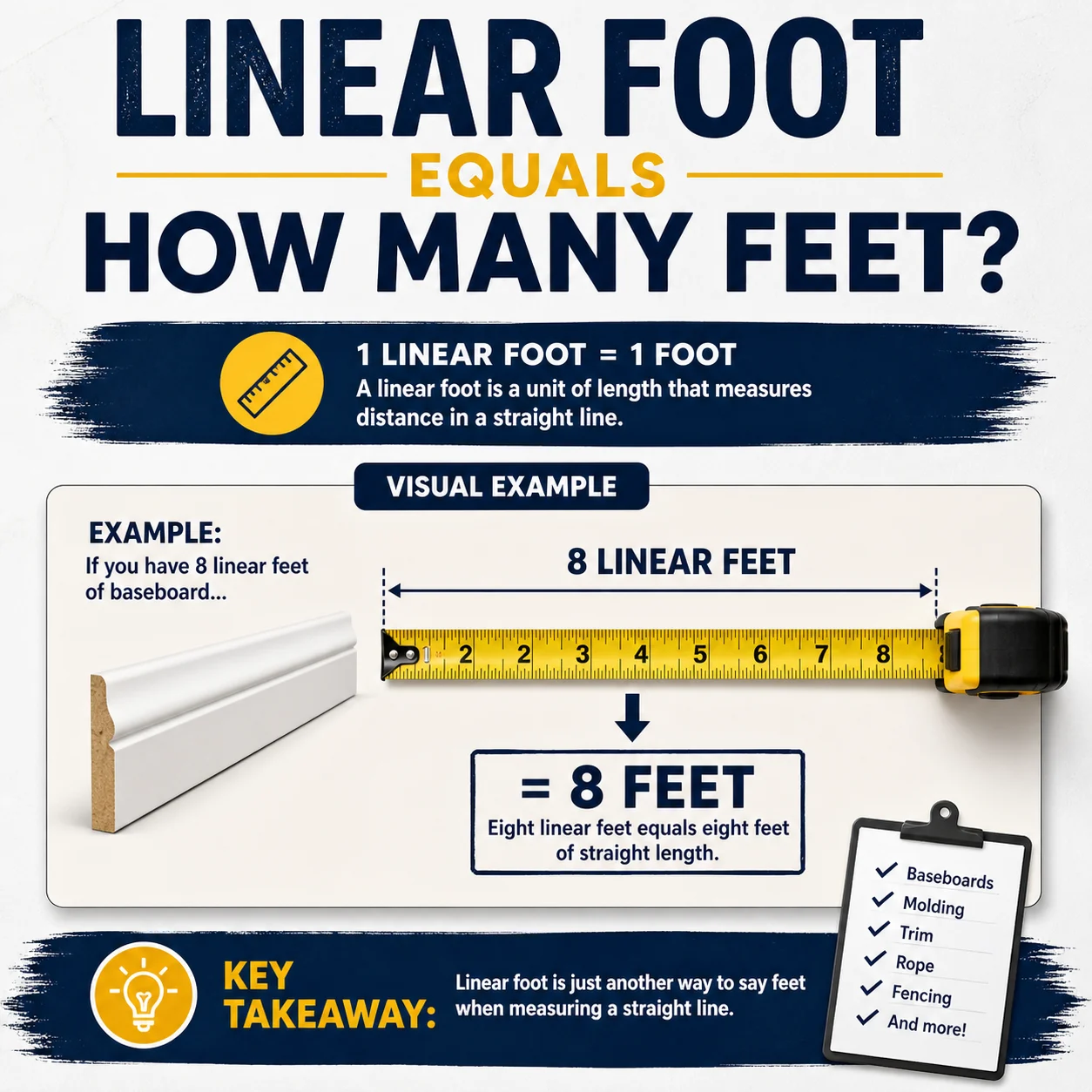
A linear foot equals exactly 1 foot.
Yes, that’s it.
But here’s where people get confused: the term linear foot doesn’t change the length — it simply describes how the measurement is being used. In this guide, you’ll learn what linear feet really mean, how they differ from other measurements, and how to use them correctly in real-life situations.
What Does 1 Linear Foot Equal?
Let’s start with the direct answer:
👉 1 linear foot = 1 foot (12 inches)
There is no conversion needed.
So why add the word “linear”?
Because it tells you that the measurement is only about length, not width or height.
What Is a Linear Foot?
A linear foot is a measurement of length in a straight line.
It’s used when you only care about one dimension — how long something is.
Simple Definition:
A linear foot measures length only, not area or volume.
Example:
- A 10-foot rope = 10 linear feet
- A 6-foot table = 6 linear feet
- A 12-foot wall = 12 linear feet
No matter what you’re measuring, if it’s just length, you’re working in linear feet.
Linear Foot vs Regular Foot: Is There a Difference?
Here’s the truth:
👉 There is NO difference between a linear foot and a regular foot in length.
Both equal:
- 12 inches
- 0.3048 meters
So why use “linear”?
The word “linear” adds context. It tells you:
- You’re measuring length only
- You’re NOT measuring area or volume
Quick Comparison:
| Term | Meaning |
|---|---|
| Foot | General unit of length |
| Linear Foot | Length in a straight line |
So, 1 linear foot equals how many feet?
👉 Still just 1 foot.
Linear Feet vs Square Feet vs Cubic Feet
This is where many people get confused.
Let’s break it down clearly:
| Measurement Type | What It Measures | Example |
|---|---|---|
| Linear Feet | Length | Fence length |
| Square Feet | Area (L × W) | Floor space |
| Cubic Feet | Volume (L × W × H) | Storage box |
Example:
- A 10-foot long board = 10 linear feet
- A 10×10 room = 100 square feet
- A box 2×2×2 = 8 cubic feet
👉 Key takeaway:
Linear feet only measure length — nothing else.
How to Measure Linear Feet (Step-by-Step)
Measuring linear feet is easy if you follow these steps:
Step 1: Get a Measuring Tool
Use:
- Tape measure
- Ruler
- Laser measurer
Step 2: Measure the Length
Measure the object from one end to the other.
Step 3: Record in Feet
If needed, convert inches to feet:
- 12 inches = 1 foot
Example:
You measure a board:
- Length = 96 inches
- Convert: 96 ÷ 12 = 8 feet
👉 Result: 8 linear feet
Real-Life Examples of Linear Feet
Understanding real-world uses makes this concept clearer.
1. Flooring
When installing baseboards:
- A room perimeter = 40 feet
👉 You need 40 linear feet of baseboard
2. Lumber
A wooden plank:
- Length = 12 feet
👉 That’s 12 linear feet
3. Fabric
Buying fabric:
- You request 5 feet
👉 You get 5 linear feet of fabric
4. Fencing
Fence around yard:
- Total length = 100 feet
👉 You need 100 linear feet of fencing
Why Linear Feet Matter in Projects
Linear feet are essential for planning and budgeting.
1. Accurate Cost Calculation
Many materials are priced per linear foot:
- Lumber
- Pipes
- Trim
Example:
- Price: $5 per linear foot
- Needed: 20 feet
👉 Total = $100
2. Efficient Material Planning
Knowing linear feet helps avoid:
- Overbuying
- Wasting materials
- Project delays
Common Mistakes People Make
Even though the concept is simple, mistakes happen often.
1. Confusing Linear Feet with Square Feet
❌ Wrong: Using linear feet for flooring area
✅ Correct: Use square feet for area
2. Ignoring Width and Height
Linear feet don’t include:
- Width
- Thickness
3. Incorrect Conversions
Forgetting:
- 12 inches = 1 foot
4. Overcomplicating the Concept
People assume it’s different from a foot — it’s not.
👉 Remember:
1 linear foot = 1 foot
Expert Tips for Accurate Measurement
Want to avoid errors? Follow these tips:
- Always measure twice
- Use a quality tape measure
- Round up slightly for safety
- Label your measurements clearly
- Keep units consistent
Quick Conversion Chart
| Feet | Linear Feet | Inches |
|---|---|---|
| 1 | 1 | 12 |
| 5 | 5 | 60 |
| 10 | 10 | 120 |
| 20 | 20 | 240 |
| 50 | 50 | 600 |
👉 Notice:
Linear feet and feet are always the same.
When Should You Use Linear Feet?
Use linear feet when measuring:
- Length of walls
- Pipes and cables
- Wood trim
- Fabric
- Fencing
- Shelving
Avoid using linear feet for:
- Floor area → use square feet
- Storage space → use cubic feet
FAQs
1. Is a linear foot the same as a foot?
Yes. A linear foot is exactly the same as a standard foot — 12 inches.
2. Why do people say linear feet instead of feet?
It clarifies that only length is being measured, not area or volume.
3. How many inches are in a linear foot?
There are 12 inches in 1 linear foot.
4. Can linear feet be converted to square feet?
Not directly. You need width to calculate square feet.
5. How do I calculate linear feet for a room?
Measure the perimeter (add all wall lengths). That total equals linear feet.
Conclusion
So, let’s settle it once and for all:
👉 1 linear foot equals how many feet?
It equals exactly 1 foot.
The term “linear” doesn’t change the measurement — it simply tells you that you’re measuring length in a straight line, not area or volume.
Understanding this concept can save you time, money, and confusion — especially when working on home projects, buying materials, or learning measurements.
Next time you see “linear feet,” you’ll know there’s nothing tricky about it — just simple length, measured clearly and correctly.