

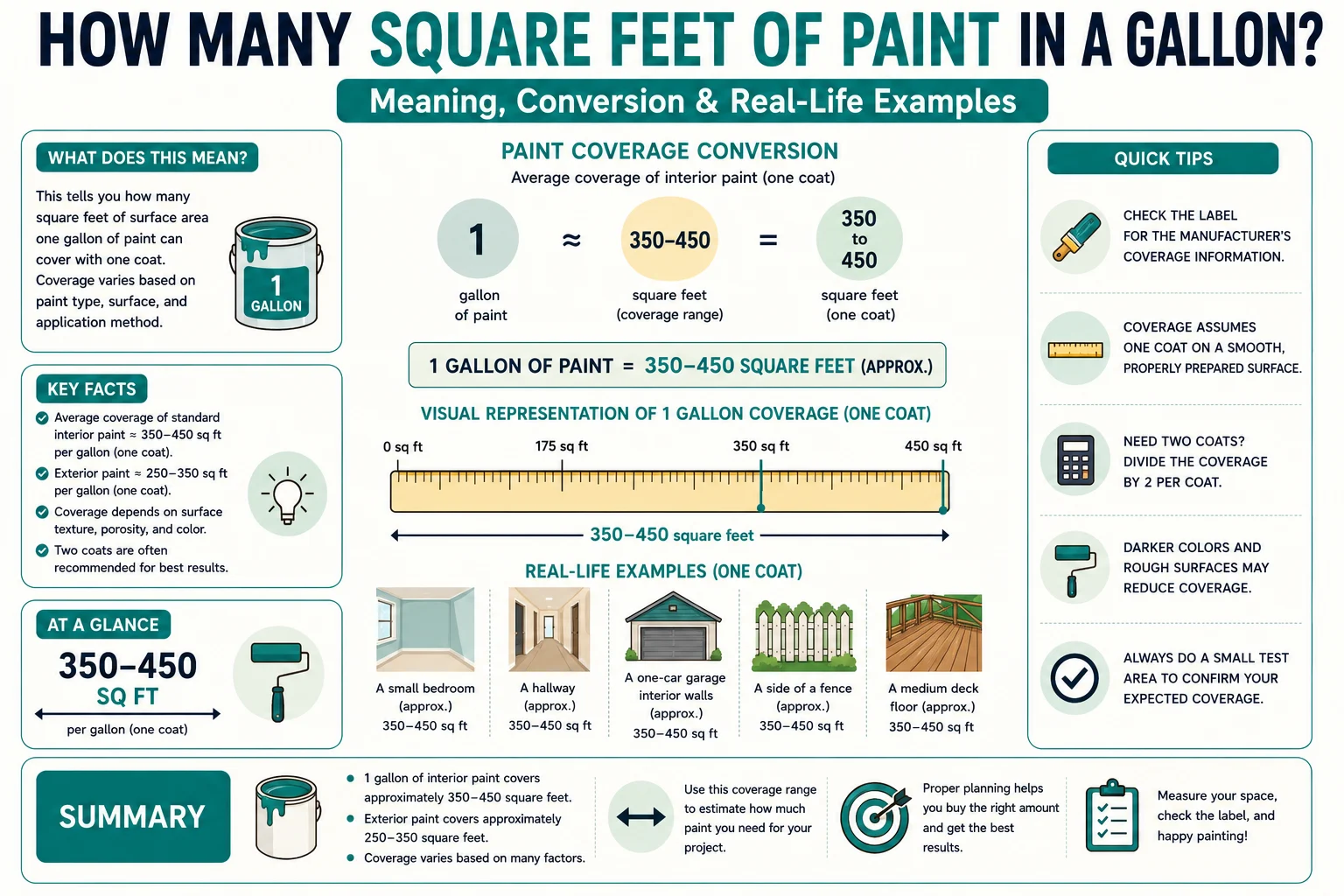
If you’re planning a painting project, one of the first questions you’ll likely ask is: how many square feet of paint in a gallon?
In most cases, one gallon of paint covers approximately 350 to 400 square feet with a single coat on a smooth, properly prepared surface. However, actual coverage can vary depending on the paint type, wall texture, color changes, and the number of coats required.
Understanding paint coverage helps you buy the right amount of paint, avoid costly mistakes, and prevent unnecessary trips to the store. Whether you’re painting a bedroom, living room, exterior wall, or entire home, knowing how much area a gallon of paint covers is essential.
This guide explains everything you need to know about paint coverage, including charts, formulas, examples, and expert tips.
Quick Answer: How Many Square Feet of Paint in a Gallon?
The standard estimate used by paint manufacturers is:
| Paint Amount | Approximate Coverage |
|---|---|
| 1 Quart | 80–100 sq ft |
| 1 Gallon | 350–400 sq ft |
| 2 Gallons | 700–800 sq ft |
| 5 Gallons | 1,750–2,000 sq ft |
For most interior projects:
- 1 gallon covers about 350–400 square feet
- 2 gallons cover about 700–800 square feet
- 5 gallons cover about 1,750–2,000 square feet
These estimates assume smooth walls and one coat of paint.
Understanding Paint Coverage
Paint coverage is not always identical from one project to another.
Several factors affect how much area a gallon of paint can cover.
What Is Paint Coverage?
Paint coverage refers to the total surface area that a specific amount of paint can cover.
Manufacturers usually list coverage directly on the paint can.
Coverage estimates assume:
- Proper surface preparation
- Standard application methods
- Average wall texture
- Single-coat application
Why Coverage Varies
A gallon of paint may cover less area if:
- The wall is rough or textured
- The surface absorbs paint
- You’re painting over a dark color
- Multiple coats are required
This is why professional painters often purchase slightly more paint than calculations suggest.
How Many Square Feet of Paint in a Gallon for Different Surfaces?
Different surfaces absorb paint differently.
Smooth Walls
Smooth drywall or previously painted walls typically provide the best coverage.
| Surface Type | Coverage per Gallon |
|---|---|
| Smooth Interior Walls | 350–400 sq ft |
| Primed Drywall | 350–400 sq ft |
| Finished Ceilings | 300–400 sq ft |
Smooth surfaces require less paint because they absorb less material.
Textured Walls
Textured walls contain more surface area.
Examples include:
- Orange peel texture
- Knockdown texture
- Stucco finishes
Coverage may drop to:
- 250–350 square feet per gallon
Exterior Surfaces
Exterior materials often absorb more paint.
| Exterior Surface | Coverage per Gallon |
|---|---|
| Wood Siding | 250–350 sq ft |
| Stucco | 150–250 sq ft |
| Brick | 150–300 sq ft |
| Fiber Cement | 250–350 sq ft |
Exterior painting usually requires more paint than interior projects.
Paint Coverage Chart by Gallon Size
Use this chart for quick estimates.
| Paint Quantity | Single Coat Coverage |
|---|---|
| 1 Quart | 80–100 sq ft |
| 1 Gallon | 350–400 sq ft |
| 2 Gallons | 700–800 sq ft |
| 3 Gallons | 1,050–1,200 sq ft |
| 5 Gallons | 1,750–2,000 sq ft |
For two coats, simply double the paint requirement.
How to Calculate Paint Needed for a Room
Calculating paint is easier than many homeowners think.
Measure Wall Area
Use this formula:
Wall Area = Length × Height
For multiple walls:
Add all wall areas together.
Example:
- Wall 1 = 12 × 8 = 96 sq ft
- Wall 2 = 12 × 8 = 96 sq ft
- Wall 3 = 10 × 8 = 80 sq ft
- Wall 4 = 10 × 8 = 80 sq ft
Total:
96 + 96 + 80 + 80 = 352 sq ft
Subtract Doors and Windows
Average measurements:
| Feature | Approximate Area |
|---|---|
| Standard Door | 20 sq ft |
| Average Window | 15 sq ft |
Subtract these areas from the total wall area.
Calculate Multiple Coats
If your room requires two coats:
352 × 2 = 704 sq ft
At 350 sq ft per gallon:
704 ÷ 350 = 2 gallons
Always round up when purchasing paint.
Real-World Paint Coverage Examples
Bedroom Example
Bedroom dimensions:
- 12 ft × 12 ft
- 8 ft ceilings
Approximate paintable wall area:
384 sq ft
Paint needed:
- One coat = about 1 gallon
- Two coats = about 2 gallons
Living Room Example
Living room dimensions:
- 20 ft × 15 ft
- 8 ft ceilings
Paintable wall area:
560 sq ft
Paint needed:
- One coat = 2 gallons
- Two coats = 3–4 gallons
Exterior House Example
A small house exterior may contain:
- 1,500 square feet of paintable surface
Paint required:
- 4–6 gallons per coat
Textured surfaces may require additional paint.
Factors That Affect Paint Coverage
Several conditions can increase or decrease paint coverage.
Surface Texture
Rough surfaces create more area for paint to cover.
Examples include:
- Stucco
- Brick
- Textured drywall
These surfaces require more paint.
Paint Quality
Premium paints often provide:
- Better coverage
- Better hiding ability
- Fewer coats
Cheaper paints may require extra coats, increasing total cost.
Color Changes
Painting a light color over a dark wall often requires:
- Two or three coats
Likewise, dramatic color changes can reduce coverage.
Primer Usage
Primer improves coverage by sealing porous surfaces.
Benefits include:
- Less paint absorption
- Better adhesion
- More uniform finish
Using primer can actually reduce overall paint costs.
Common Mistakes When Estimating Paint
Many homeowners miscalculate paint requirements.
Ignoring Multiple Coats
Coverage labels usually refer to one coat.
Most rooms need:
- Two coats for best results
Forgetting Surface Texture
Textured surfaces consume significantly more paint.
Not Measuring Accurately
Estimating room dimensions often leads to purchasing too much or too little paint.
Skipping Primer
Unprimed surfaces absorb more paint and reduce coverage.
Buying Exact Amounts
Running out of paint mid-project can create color consistency issues.
Always buy slightly extra.
Expert Tips to Reduce Paint Waste
Professional painters use several strategies to maximize coverage.
Prepare the Surface Properly
Clean walls before painting.
Remove:
- Dust
- Grease
- Dirt
This improves paint adhesion.
Use Quality Tools
High-quality:
- Rollers
- Brushes
- Sprayers
help distribute paint more efficiently.
Prime When Necessary
Primer reduces absorption and improves final appearance.
Buy High-Quality Paint
Premium paint often costs more upfront but requires fewer coats.
Keep Extra Paint
Store leftover paint for future touch-ups.
Label each can with:
- Room name
- Paint color
- Date used
Conclusion
So, how many square feet of paint in a gallon?
For most interior painting projects, one gallon of paint covers approximately 350 to 400 square feet with a single coat. However, actual coverage depends on factors such as wall texture, paint quality, surface condition, and the number of coats required.
Before purchasing paint, remember to:
- Measure accurately
- Account for doors and windows
- Consider multiple coats
- Factor in surface texture
- Buy a little extra for touch-ups
Understanding paint coverage helps you save money, reduce waste, and achieve professional-looking results on any painting project.
FAQs
How many square feet does one gallon of paint cover?
Most gallons of paint cover approximately 350–400 square feet with one coat on a smooth surface.
Is one gallon of paint enough for a room?
For many small bedrooms, one gallon is enough for a single coat. Two coats may require two gallons.
How much paint do I need for 1,000 square feet?
For one coat, you typically need about 3 gallons. For two coats, plan on 5–6 gallons depending on surface conditions.
Does textured wall paint require more paint?
Yes. Textured walls increase surface area and often reduce coverage to 250–350 square feet per gallon.
Should I buy extra paint?
Yes. Purchasing 10–15% extra paint helps cover touch-ups, mistakes, and future repairs.
Search More
How Many Feet in a Yard of Dirt?