
If you’ve ever wondered how many steps in 50 feet, you’re not alone. This is a common question for walkers, runners, hikers, fitness enthusiasts, and even homeowners measuring short distances without a tape measure.
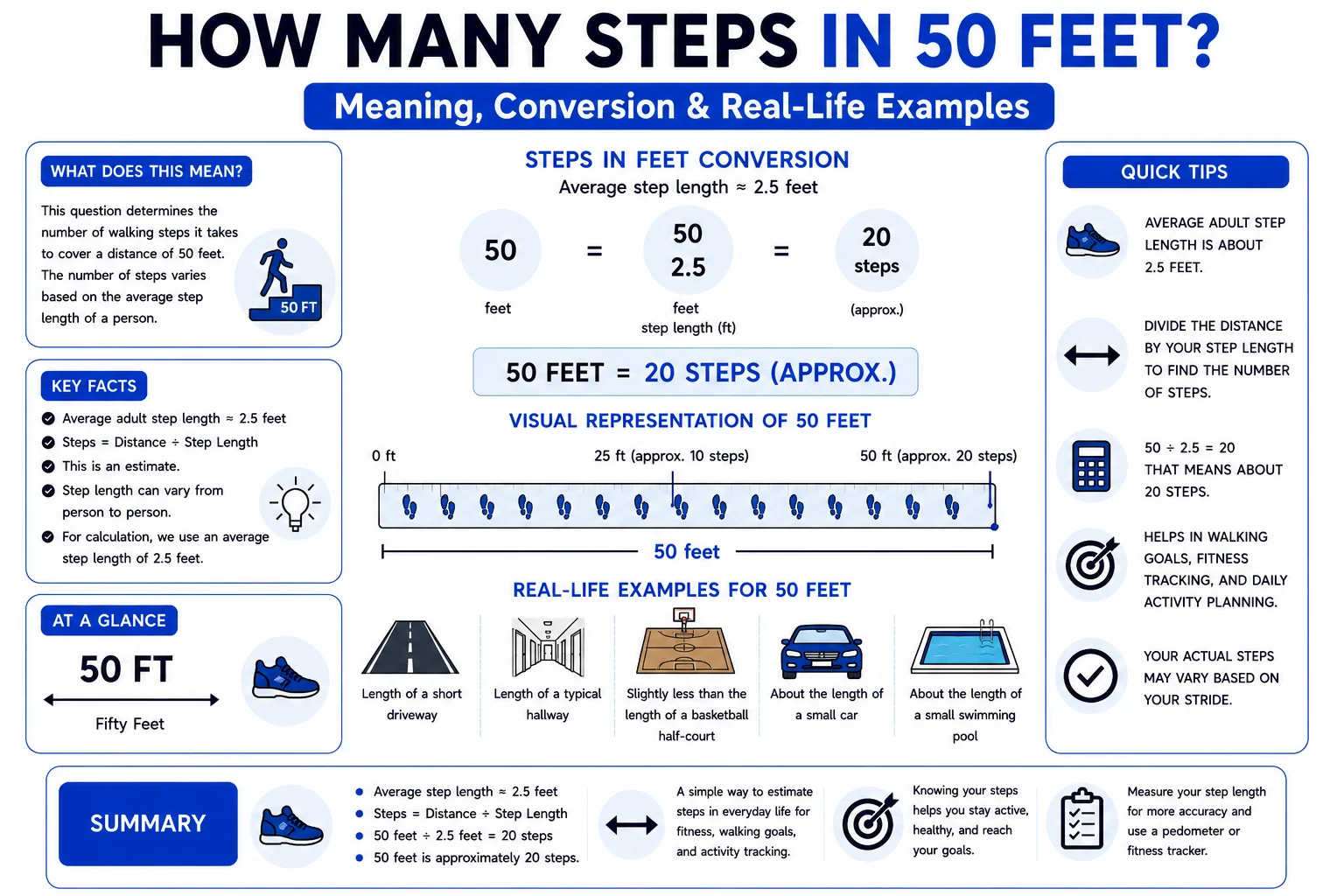
The short answer is that 50 feet equals approximately 20 to 25 steps for the average adult. However, the exact number depends on your stride length, height, walking speed, and terrain.
Knowing how to convert feet into steps can help with fitness tracking, outdoor activities, construction projects, and everyday distance estimation. Instead of carrying measuring tools everywhere, you can use your own walking pace to estimate distances quickly.
This guide explains everything you need to know about converting 50 feet into steps, including formulas, charts, real-world examples, and practical applications.
Quick Answer: How Many Steps in 50 Feet?
For most adults, walking 50 feet takes approximately:
| Step Length | Steps in 50 Feet |
|---|---|
| 2.0 feet | 25 steps |
| 2.2 feet | 23 steps |
| 2.5 feet | 20 steps |
| 2.7 feet | 19 steps |
A good average estimate is:
50 feet = about 22 to 23 steps
If you are taller and have a longer stride, you may need fewer steps. If you are shorter or walking slowly, you may need more.
Understanding Step Length and Stride Length
Before calculating steps, it’s important to understand the difference between a step and a stride.
What Is a Step?
A step is the distance between one foot and the other during walking.
For example:
- Right foot to left foot = one step
- Left foot to right foot = another step
Most adults have an average step length of:
- 2 to 2.5 feet
What Is a Stride?
A stride is different from a step.
A stride measures the distance from one foot hitting the ground until the same foot hits the ground again.
In simple terms:
- One stride = two steps
Many people confuse these measurements, which can lead to incorrect distance estimates.
How Many Steps in 50 Feet for Different People?
Everyone walks differently. Height, age, and walking style all affect the number of steps required to cover 50 feet.
Average Adult
The average adult step length is approximately 2.2 feet.
Using that measurement:
50 ÷ 2.2 = 22.7
This means the average adult takes about:
- 23 steps to walk 50 feet
Men vs Women
Because men tend to have longer legs on average, they often take fewer steps.
| Group | Average Step Length | Steps in 50 Feet |
|---|---|---|
| Men | 2.5 feet | 20 steps |
| Women | 2.2 feet | 23 steps |
These numbers are estimates and can vary significantly.
Children
Children generally have shorter legs and shorter strides.
| Age Group | Steps in 50 Feet |
|---|---|
| Young Children | 30–35 steps |
| Older Children | 25–30 steps |
| Teenagers | 22–26 steps |
As children grow, their stride length increases and the number of steps decreases.
50 Feet to Steps Conversion Chart
The following chart can help you estimate step counts quickly.
| Average Step Length | Approximate Steps |
|---|---|
| 1.5 feet | 33 steps |
| 1.8 feet | 28 steps |
| 2.0 feet | 25 steps |
| 2.2 feet | 23 steps |
| 2.4 feet | 21 steps |
| 2.5 feet | 20 steps |
| 2.7 feet | 19 steps |
| 3.0 feet | 17 steps |
This chart works well for quick estimates when measuring tools aren’t available.
How to Calculate Your Personal Steps in 50 Feet
Using average numbers is helpful, but measuring your own stride provides the most accurate results.
Measure Your Step Length
Follow these simple steps:
- Measure a straight path of 20 feet.
- Walk naturally along the path.
- Count your total steps.
- Divide the distance by the number of steps.
Example:
- Distance = 20 feet
- Steps = 9
20 ÷ 9 = 2.22 feet per step
Now you know your personal step length.
Simple Formula
Use this formula:
Steps = Distance ÷ Step Length
For example:
- Distance = 50 feet
- Step Length = 2.22 feet
50 ÷ 2.22 = 22.5 steps
Your answer would be approximately 23 steps.
Real-World Examples of 50 Feet
Many people struggle to visualize 50 feet.
Here are some common comparisons:
- About five standard parking spaces
- Half the length of a basketball court
- Around the length of a semi-truck trailer
- Roughly the width of a small residential lot
- About the height of a five-story building
Understanding these comparisons can help you estimate distances more accurately.
Why Step Counts Vary
No two people walk exactly the same way.
Several factors affect step counts.
Height
Taller people usually take longer strides.
As a result:
- Fewer steps are needed
- Distances are covered more quickly
Shorter individuals often need more steps to travel the same distance.
Walking Speed
When people walk faster, their strides often become longer.
This means:
- Faster walking = fewer steps
- Slower walking = more steps
The difference can be noticeable over longer distances.
Terrain
Walking surface matters.
You may take shorter steps on:
- Sand
- Grass
- Gravel
- Hills
- Uneven trails
Because of this, you may need more steps to cover 50 feet outdoors than indoors.
Fitness Level
Experienced walkers and athletes often have efficient stride patterns.
Their movement can reduce the number of steps needed to travel a given distance.
Benefits of Knowing Steps in 50 Feet
Understanding how many steps are in 50 feet offers several practical benefits.
Better Fitness Tracking
Many fitness goals are based on step counts.
Knowing distance conversions helps you:
- Track walking goals
- Estimate exercise distances
- Improve workout planning
Easier Distance Measurement
You can estimate short distances without:
- Tape measures
- Measuring wheels
- Survey equipment
Helpful for Hiking
Hikers often use pacing techniques to estimate distances on trails.
Useful for Construction Projects
Contractors frequently estimate distances using step counts before taking precise measurements.
Improved Running and Sports Training
Athletes can use step-based measurements for:
- Sprint drills
- Practice layouts
- Agility training
Common Mistakes When Converting Feet to Steps
Many people make simple errors when estimating steps.
Assuming Everyone Has the Same Stride
Stride length varies from person to person.
Using someone else’s measurements can lead to inaccurate results.
Confusing Steps and Strides
Remember:
- One stride equals approximately two steps
Mixing these terms can double or halve your estimate.
Ignoring Terrain
Walking on grass or uneven surfaces often shortens your stride.
Using Running Measurements
Running strides are much longer than walking strides.
Always use the correct stride length for the activity you’re measuring.
Not Measuring Your Own Step Length
The most accurate results come from personal measurements.
A few minutes of testing can greatly improve accuracy.
Conclusion
So, how many steps in 50 feet?
For most adults, 50 feet equals approximately 20 to 25 steps, with the average person taking around 22 to 23 steps.
The exact number depends on:
- Height
- Stride length
- Walking speed
- Terrain
- Fitness level
While average estimates are useful, measuring your own step length will always provide the most accurate answer.
Whether you’re tracking fitness goals, estimating distances, hiking, or planning a project, understanding how many steps are in 50 feet is a practical skill that can save time and improve accuracy.
FAQs
How many walking steps are in 50 feet?
Most adults take between 20 and 25 steps to walk 50 feet.
How many steps is 50 feet for an average person?
The average adult takes approximately 22 to 23 steps to cover 50 feet.
Does height affect how many steps are in 50 feet?
Yes. Taller people usually have longer strides and therefore take fewer steps.
How many running steps are in 50 feet?
Most runners cover 50 feet in approximately 15 to 20 steps depending on speed and stride length.
What formula converts feet to steps?
Use this formula:
Steps = Distance in Feet ÷ Average Step Length in Feet
This provides a personalized estimate based on your own walking pattern.
Discover More
How Many Feet in a Yard of Dirt?
How Many Square Feet for 1 Ton AC?