

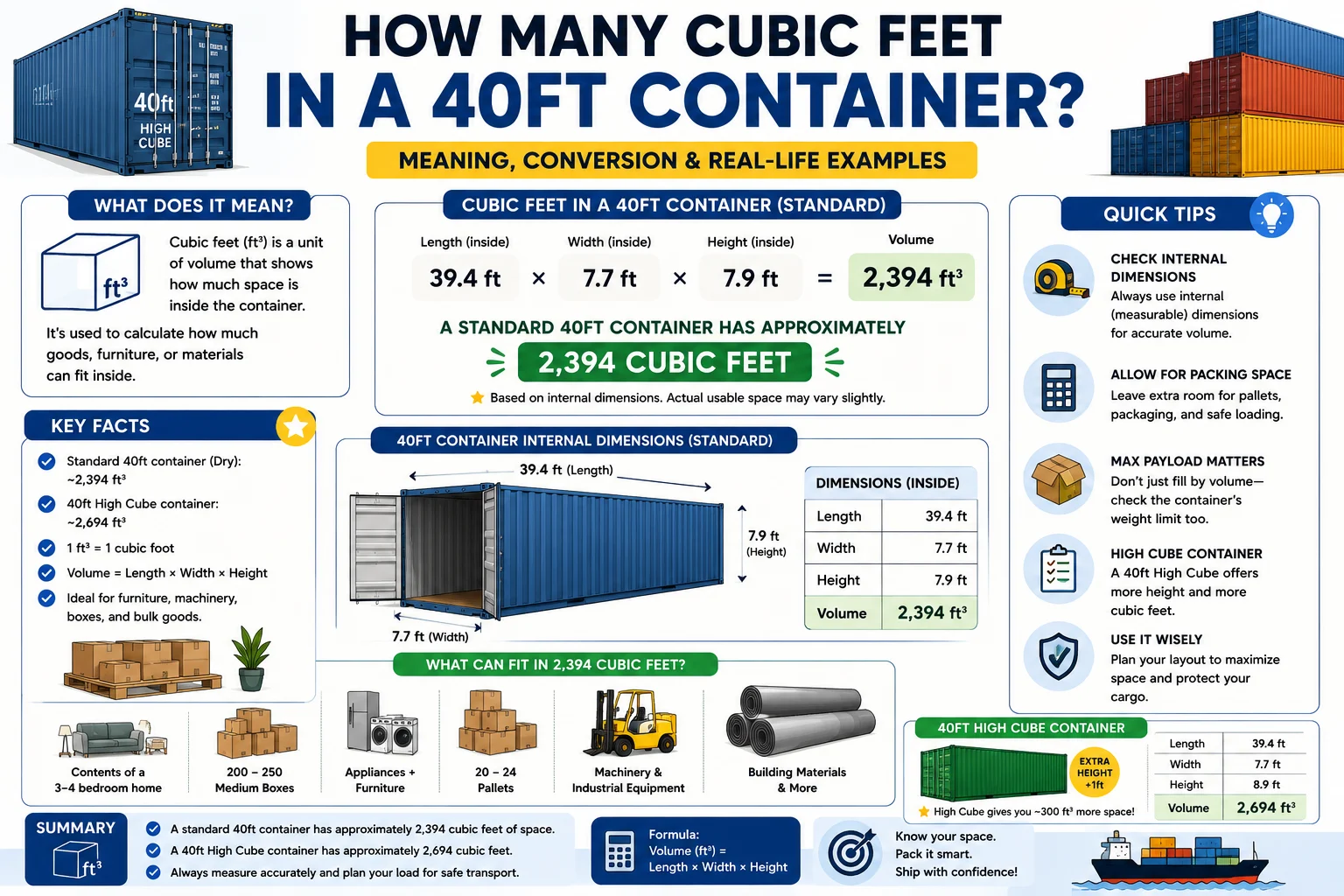
If you’re wondering how many cubic feet in a 40ft container, the short answer is that a standard 40-foot shipping container typically holds about 2,390 cubic feet of internal cargo space. A 40ft high cube container provides even more room, offering approximately 2,694 cubic feet of storage capacity.
Understanding container volume is essential for shipping, storage, logistics planning, and freight cost calculations. Whether you’re moving household goods, exporting products internationally, or organizing warehouse inventory, knowing the cubic capacity of a container helps ensure efficient use of space.
In this guide, you’ll learn exactly how many cubic feet a 40ft container holds, how those figures are calculated, and how to maximize the available storage volume.
Quick Answer
Here are the most common container capacities:
| Container Type | Cubic Feet Capacity |
|---|---|
| Standard 40ft Container | Approximately 2,390 cu ft |
| 40ft High Cube Container | Approximately 2,694 cu ft |
These figures represent usable internal volume rather than external dimensions.
Understanding 40ft Shipping Containers
A 40-foot shipping container is one of the most widely used cargo containers in global trade.
These containers are designed to:
- Transport goods internationally
- Store inventory
- Serve as temporary warehouses
- Support relocation and moving projects
- Facilitate intermodal transportation
Because they can be transferred between ships, trains, and trucks, they have become a cornerstone of modern logistics.
How Many Cubic Feet in a 40ft Container?
The internal volume of a standard 40ft container is approximately:
2,390 cubic feet
This figure comes from multiplying the interior dimensions:
- Length: approximately 39.5 feet
- Width: approximately 7.7 feet
- Height: approximately 7.9 feet
The resulting volume is roughly:
2,390 cubic feet
This represents the maximum interior space available for cargo.
Quick Volume Comparison
| Container Size | Approximate Cubic Feet |
|---|---|
| 20ft Container | 1,172 cu ft |
| 40ft Container | 2,390 cu ft |
| 40ft High Cube | 2,694 cu ft |
A 40ft container offers more than double the volume of a standard 20ft container.
Standard vs High Cube 40ft Containers
Many people assume all 40ft containers are identical. However, there are important differences.
Standard 40ft Container
Typical specifications:
| Feature | Measurement |
|---|---|
| Length | 40 ft |
| Width | 8 ft |
| Height | 8 ft 6 in |
| Volume | 2,390 cu ft |
40ft High Cube Container
A high cube container adds approximately one extra foot of height.
Typical specifications:
| Feature | Measurement |
|---|---|
| Length | 40 ft |
| Width | 8 ft |
| Height | 9 ft 6 in |
| Volume | 2,694 cu ft |
Additional Capacity
The extra height provides:
- More cargo volume
- Better storage efficiency
- Greater flexibility for bulky items
This makes high cube containers popular in many industries.
Interior Dimensions of a 40ft Container
Understanding interior measurements helps estimate storage capacity more accurately.
Standard 40ft Container Interior
| Dimension | Approximate Size |
|---|---|
| Length | 39.5 ft |
| Width | 7.7 ft |
| Height | 7.9 ft |
High Cube Interior
| Dimension | Approximate Size |
|---|---|
| Length | 39.5 ft |
| Width | 7.7 ft |
| Height | 8.9 ft |
These measurements may vary slightly depending on the manufacturer.
How to Calculate Container Volume
Calculating cubic feet is straightforward.
Formula
Volume = Length × Width × Height
For example:
39.5 × 7.7 × 7.9
= approximately 2,390 cubic feet
This simple formula can be used for nearly any storage container.
Why Cubic Feet Matter
Cubic feet help determine:
- Cargo capacity
- Freight planning
- Storage efficiency
- Shipping costs
- Inventory organization
Understanding volume prevents costly shipping mistakes.
Real-World Storage Examples
Many people struggle to visualize 2,390 cubic feet.
Here are some practical comparisons.
Household Move
A standard 40ft container can often hold:
- Furniture from a 3–5 bedroom home
- Appliances
- Boxes
- Outdoor equipment
Business Inventory
A 40ft container may store:
- Thousands of packaged products
- Palletized goods
- Retail inventory
- Manufacturing supplies
Construction Materials
It can accommodate:
- Lumber
- Roofing materials
- Equipment
- Building supplies
Actual capacity depends on weight and packaging.
What Can Fit Inside a 40ft Container?
The answer depends on cargo dimensions and stacking methods.
Typical Cargo Examples
| Item | Approximate Quantity |
|---|---|
| Standard Pallets | 20–25 |
| Household Boxes | Hundreds |
| Bicycles | 300+ |
| Mattresses | 200+ |
| Office Chairs | Several hundred |
Proper packing dramatically influences usable capacity.
Factors Affecting Capacity
- Item shape
- Weight limits
- Packaging materials
- Stacking efficiency
- Fragility requirements
Not every cubic foot can always be utilized perfectly.
Benefits of Using a 40ft Container
High Storage Capacity
With approximately 2,390 cubic feet, a 40ft container provides substantial storage space.
Cost Efficiency
Larger containers often reduce shipping costs per unit.
Versatility
Suitable for:
- Storage
- Transportation
- Construction projects
- Retail inventory
- Emergency shelters
Security
Containers provide durable steel protection against weather and theft.
Global Availability
40ft containers are standardized and widely available worldwide.
Common Mistakes When Estimating Container Capacity
Many shippers overestimate available space.
Ignoring Packaging
Boxes and pallets consume additional volume.
Forgetting Weight Limits
Even if space remains, weight restrictions may prevent additional loading.
Poor Stacking Practices
Inefficient packing can waste hundreds of cubic feet.
Using External Dimensions
Cargo capacity depends on internal dimensions, not exterior measurements.
Neglecting Door Clearance
Some large items may not fit through container doors despite fitting inside the overall volume.
Expert Tips for Maximizing Container Space
Use Uniform Box Sizes
Consistent packaging improves stacking efficiency.
Stack Vertically
Take advantage of the full interior height.
Load Heavy Items First
Place heavier cargo near the floor for stability.
Eliminate Empty Gaps
Use smaller boxes to fill unused spaces.
Create a Loading Plan
Planning cargo placement before loading can significantly increase usable capacity.
Consider High Cube Containers
If volume is more important than weight, high cube containers often provide better value.
Conclusion
If you’re asking how many cubic feet in a 40ft container, the standard answer is approximately 2,390 cubic feet for a standard container and 2,694 cubic feet for a 40ft high cube container.
These containers play a critical role in global shipping, storage, and logistics because they offer substantial cargo capacity while remaining easy to transport. Understanding container volume helps businesses, movers, and logistics professionals maximize efficiency, reduce costs, and avoid costly shipping mistakes.
Whether you’re planning an international shipment, organizing warehouse storage, or relocating household goods, knowing the cubic capacity of a 40ft container is essential for accurate planning and successful transportation.
FAQs
How many cubic feet does a standard 40ft container hold?
A standard 40ft shipping container holds approximately 2,390 cubic feet of internal volume.
How many cubic feet are in a 40ft high cube container?
A 40ft high cube container typically offers about 2,694 cubic feet of storage space.
What is the difference between a standard and high cube container?
A high cube container is approximately one foot taller, providing additional cargo volume.
How many pallets fit in a 40ft container?
Most 40ft containers can accommodate approximately 20 to 25 standard pallets, depending on pallet size and loading configuration.
Why is cubic feet important in shipping?
Cubic feet measurements help determine cargo capacity, freight planning, storage requirements, and overall shipping efficiency.
Find Out MORE
How Many Feet of Intestines Do Dogs Have?
How Many Feet in an Acre?
How Many Feet Does an Octopus Have?