

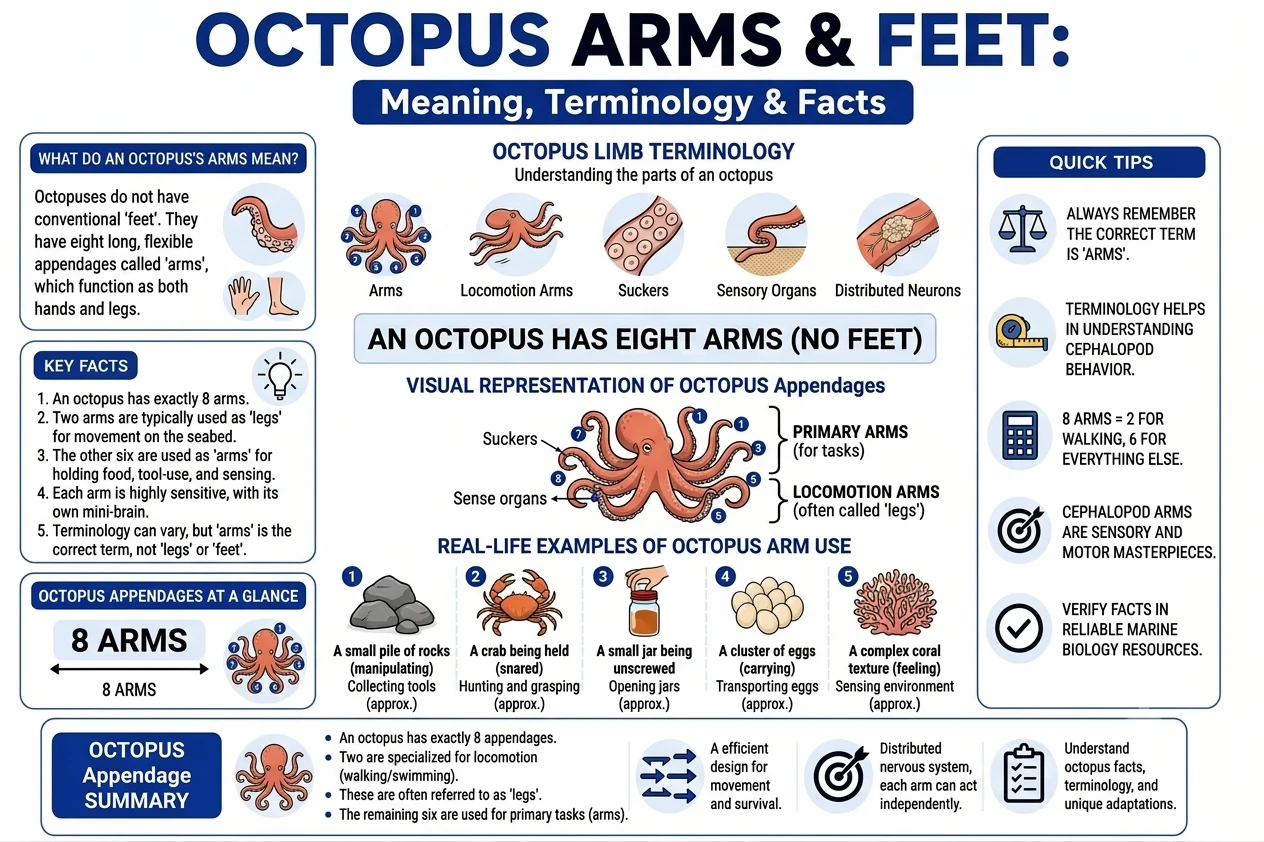
If you’ve ever wondered how many feet does an octopus have, you’re not alone. It’s one of the most common questions people ask about these fascinating sea creatures. At first glance, an octopus appears to have eight “feet” extending from its body. However, the scientific answer is a little more complicated—and much more interesting.
An octopus actually has zero feet and eight arms. While many people casually refer to these limbs as feet or tentacles, marine biologists classify them as arms because they contain suckers along their entire length and serve many different functions.
Understanding the difference between feet, arms, and tentacles helps explain why octopuses are among the most unique animals in the ocean. In this guide, you’ll learn everything about octopus anatomy, movement, behavior, and the surprising truth behind their famous eight limbs.
Quick Answer
The short answer is:
An octopus has no feet. It has eight arms.
Here is a simple breakdown:
| Body Part | Number |
|---|---|
| Feet | 0 |
| Arms | 8 |
| Tentacles | 0 |
| Suckers | Hundreds to Thousands |
So when someone asks, “How many feet does an octopus have?” the scientifically correct answer is none.
Does an Octopus Actually Have Feet?
No, an octopus does not have feet in the way humans or other animals do.
Feet are specialized structures used for:
- Walking
- Supporting body weight
- Running
- Maintaining balance
Animals such as dogs, cats, horses, and humans all possess feet because they live on land and need support for movement.
Octopuses evolved in marine environments. Instead of feet, they developed flexible arms that help them navigate underwater, catch prey, and interact with their surroundings.
These arms are far more versatile than feet and serve multiple purposes simultaneously.
Understanding Octopus Anatomy
To understand why octopuses don’t have feet, it helps to examine their anatomy.
Octopuses belong to a group of animals known as cephalopods.
Other cephalopods include:
- Squid
- Cuttlefish
- Nautiluses
The body of an octopus consists of several important parts.
| Body Part | Function |
|---|---|
| Mantle | Houses vital organs |
| Arms | Movement and feeding |
| Suckers | Gripping and sensing |
| Eyes | Vision |
| Beak | Breaking apart food |
| Brain | Intelligence and control |
Unlike most animals, an octopus lacks:
- Bones
- A skeleton
- Feet
- External protective structures
This soft-bodied design allows it to squeeze through incredibly small spaces.
How Many Arms Does an Octopus Have?
Every octopus has:
Eight arms
The name “octopus” comes from Greek words meaning “eight-footed.”
Ironically, although the name references feet, modern science identifies these appendages as arms.
Each arm contains:
- Muscles
- Nerves
- Suckers
- Sensory receptors
Researchers have discovered that a large portion of an octopus’s nervous system is actually located within its arms.
This means each arm can perform certain actions independently without waiting for instructions from the brain.
Why Are Octopus Arms Often Mistaken for Feet?
Many people mistake octopus arms for feet because of how the animal moves.
When crawling along the ocean floor, an octopus places several arms against the ground and pushes itself forward.
This movement resembles walking.
As a result, observers often assume the limbs function as feet.
However, these appendages also perform tasks that feet cannot.
For example, octopus arms can:
- Open containers
- Grab prey
- Taste objects
- Explore surfaces
- Build shelters
Because they function like both hands and feet, confusion is understandable.
Arms vs Tentacles: What’s the Difference?
Another common misconception involves tentacles.
Many people believe octopuses have tentacles, but this is incorrect.
Scientists distinguish between arms and tentacles.
| Feature | Arms | Tentacles |
|---|---|---|
| Suckers | Entire length | Mostly at tips |
| Length | Similar throughout | Usually longer |
| Found on Octopus | Yes | No |
| Found on Squid | Yes | Yes |
An octopus has:
- 8 arms
- 0 tentacles
Squid and cuttlefish possess both arms and tentacles.
Understanding this distinction helps clarify octopus anatomy.
How Octopuses Move Without Feet
Since octopuses don’t have feet, how do they travel?
They use several fascinating methods.
Crawling
Crawling is the most common movement method.
The octopus extends and contracts its arms to pull itself along the seabed.
This allows precise movement while hunting or exploring.
Swimming
Octopuses can also swim using jet propulsion.
They pull water into their mantle and forcefully expel it through a tube called a siphon.
This creates thrust and moves the animal rapidly through the water.
Climbing
Their strong suckers allow them to climb:
- Rocks
- Coral reefs
- Underwater structures
This ability gives them access to hiding places and hunting grounds.
Squeezing Through Openings
Because they have no rigid skeleton, octopuses can fit through openings barely larger than their beaks.
This skill helps them escape predators and find shelter.
Amazing Facts About Octopus Arms
Octopus arms are among the most remarkable structures in the animal kingdom.
Arms Can Taste
Each sucker contains chemical receptors.
These receptors allow the octopus to taste objects simply by touching them.
Arms Have Independent Control
An octopus arm can continue reacting to stimuli even when separated from the body.
This demonstrates the advanced nervous system within the limbs.
Incredible Flexibility
With no bones restricting movement, octopus arms can bend in virtually any direction.
Extraordinary Strength
An octopus can exert significant force with its suckers.
Some large species can easily manipulate heavy objects relative to their size.
Problem-Solving Abilities
Octopuses use their arms to:
- Open jars
- Solve puzzles
- Escape enclosures
- Manipulate tools
Few animals possess comparable dexterity.
Common Myths About Octopus Feet
Several myths persist about octopus anatomy.
Myth 1: Octopuses Have Eight Feet
Reality:
They have eight arms and no feet.
Myth 2: Octopuses Have Tentacles
Reality:
Octopuses have arms only.
Myth 3: All Arms Do the Same Thing
Reality:
Research suggests some arms may be preferred for certain tasks, similar to human handedness.
Myth 4: Octopuses Are Simple Creatures
Reality:
They are among the most intelligent invertebrates on Earth.
Myth 5: Arms Are Just for Movement
Reality:
Arms assist with feeding, sensing, defense, exploration, and communication.
Why Octopuses Are Unique Among Marine Animals
Octopuses stand out for several reasons.
High Intelligence
They can:
- Learn from experience
- Solve problems
- Recognize patterns
Camouflage Skills
Specialized skin cells allow rapid color and texture changes.
Flexible Bodies
Their lack of bones enables movement through extremely tight spaces.
Advanced Senses
Their arms provide continuous feedback about their surroundings.
Complex Behaviors
Scientists continue discovering new examples of octopus intelligence and adaptability.
These traits make octopuses some of the most fascinating creatures in the ocean.
Conclusion
So, how many feet does an octopus have?
The answer may surprise many people: an octopus has zero feet and eight arms. Although its limbs often function in ways that resemble feet, scientists classify them as arms because of their structure, suckers, and remarkable versatility.
These eight arms help octopuses move, hunt, explore, climb, communicate, and even solve problems. Combined with their intelligence and unique anatomy, octopuses remain some of the most extraordinary animals in the marine world.
The next time someone asks how many feet an octopus has, you’ll know the scientifically accurate answer—and a lot more fascinating facts besides.
FAQs
How many feet does an octopus have?
An octopus has zero feet. It has eight arms.
Does an octopus have tentacles?
No. Octopuses have arms, not tentacles.
Why is an octopus called an eight-footed animal?
The name comes from Greek roots meaning “eight-footed,” but modern biology classifies those appendages as arms.
How many arms does an octopus have?
Every octopus has eight arms lined with suckers.
Can octopus arms work independently?
Yes. Each arm contains a complex network of nerves and can perform certain actions with limited input from the brain.
Discover MORE
130 Feet Is How Many Stories?
How Many Square Feet in a Bundle of Cedar Shingles?