

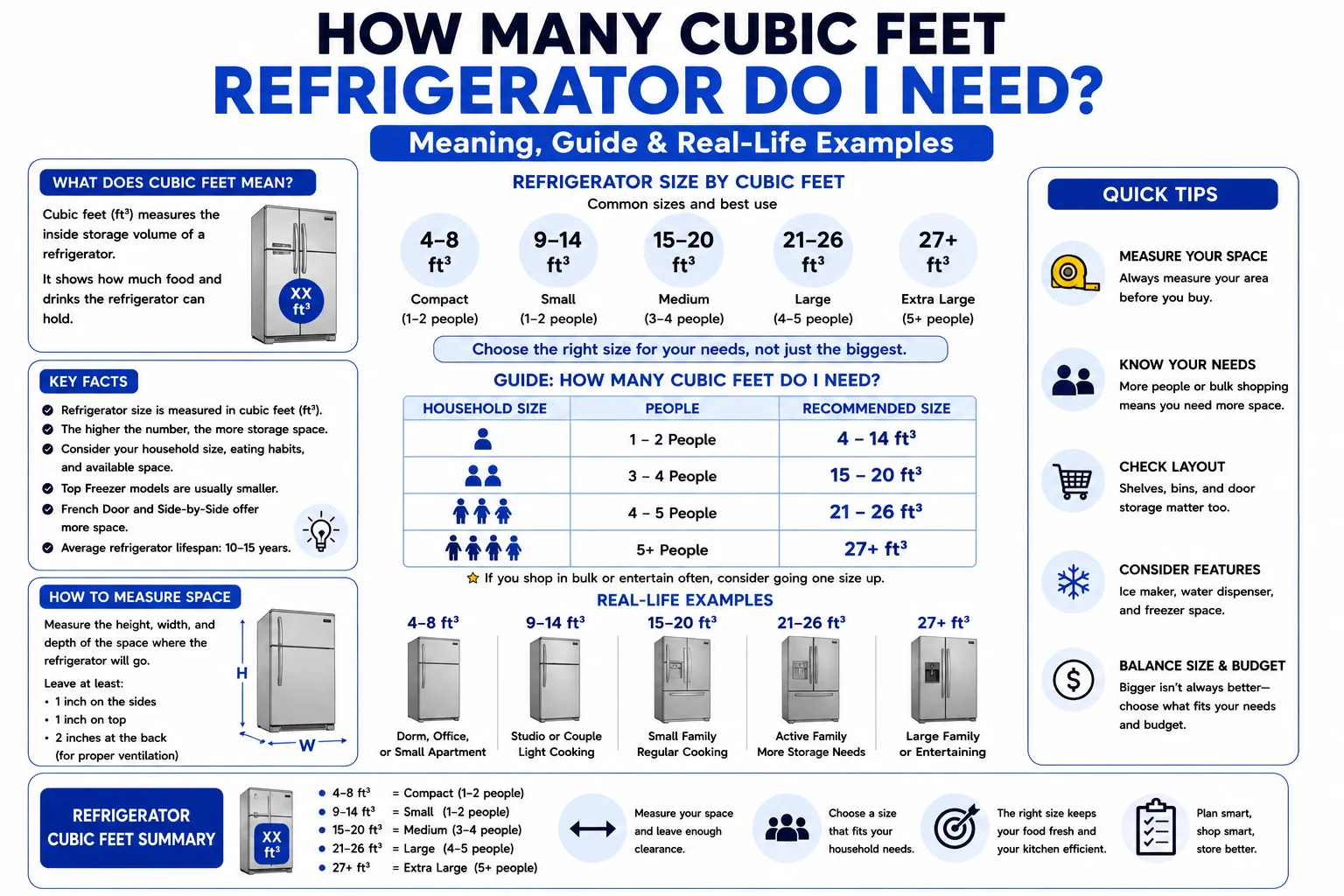
If you’re asking how many cubic feet refrigerator do I need, you’re already taking an important step toward choosing the right appliance for your kitchen. Refrigerator capacity affects food storage, energy usage, kitchen layout, and even your grocery shopping habits.
The ideal refrigerator size depends on several factors, including the number of people in your household, how often you shop, your cooking habits, and whether you need extra freezer storage.
As a general rule, experts recommend 4 to 6 cubic feet of refrigerator space per person. That means a family of four typically needs a refrigerator with a capacity of approximately 16 to 24 cubic feet.
In this guide, you’ll learn how refrigerator capacity is measured, what size works best for different households, and how to avoid common buying mistakes.
Quick Answer
Here is a quick refrigerator sizing guide:
| Household Size | Recommended Capacity |
|---|---|
| 1 Person | 10–12 Cubic Feet |
| 2 People | 12–16 Cubic Feet |
| 3 People | 16–20 Cubic Feet |
| 4 People | 18–25 Cubic Feet |
| 5+ People | 25+ Cubic Feet |
Most families find that a refrigerator between 18 and 25 cubic feet offers the best balance between storage space and efficiency.
What Does Cubic Feet Mean in a Refrigerator?
Cubic feet refers to the internal storage volume of a refrigerator.
Manufacturers calculate capacity by measuring:
- Interior width
- Interior height
- Interior depth
The result indicates the total amount of usable storage space inside both the refrigerator and freezer compartments.
Example
A refrigerator rated at 20 cubic feet provides:
- Approximately 20 cubic feet of combined storage volume
- Space for fresh foods
- Space for frozen foods
- Room for beverages and meal preparation items
A higher cubic-foot rating generally means more storage capacity.
How Many Cubic Feet Refrigerator Do I Need Based on Household Size?
One of the easiest ways to determine refrigerator size is by considering household size.
Single Person Household
Recommended:
- 10–12 cubic feet
Suitable for:
- Apartments
- Studios
- Minimal grocery storage
Two-Person Household
Recommended:
- 12–16 cubic feet
Ideal for:
- Couples
- Small kitchens
- Weekly grocery shopping
Three-Person Household
Recommended:
- 16–20 cubic feet
Provides enough room for:
- Fresh produce
- Frozen foods
- Meal preparation
Four-Person Household
Recommended:
- 18–25 cubic feet
Most modern families choose refrigerators in this range.
Five or More People
Recommended:
- 25–30+ cubic feet
Larger households benefit from additional storage flexibility.
Refrigerator Size Chart
The following chart offers a quick reference.
| Family Size | Recommended Refrigerator Size |
|---|---|
| 1 Person | 10–12 cu ft |
| 2 People | 12–16 cu ft |
| 3 People | 16–20 cu ft |
| 4 People | 18–25 cu ft |
| 5 People | 25–28 cu ft |
| 6+ People | 28–30+ cu ft |
Keep in mind that shopping habits can increase or decrease your storage requirements.
Factors That Affect Refrigerator Capacity Needs
Household size isn’t the only factor.
Grocery Shopping Frequency
People who shop monthly need more refrigerator space than those who shop weekly.
Cooking Habits
If you cook most meals at home, you’ll likely require:
- More fresh food storage
- Larger produce drawers
- Additional shelf space
Entertaining Guests
Frequent entertaining often requires extra room for:
- Beverages
- Party trays
- Prepared foods
Freezer Usage
Families that buy frozen foods in bulk may need larger freezer compartments.
Lifestyle
Special diets and meal-prep routines can significantly increase storage requirements.
Types of Refrigerators and Their Typical Sizes
Different refrigerator styles offer varying capacities.
Top-Freezer Refrigerators
Typical size:
- 10–22 cubic feet
Advantages:
- Affordable
- Energy efficient
- Compact footprint
Bottom-Freezer Refrigerators
Typical size:
- 18–25 cubic feet
Advantages:
- Convenient access to fresh foods
- Modern design
Side-by-Side Refrigerators
Typical size:
- 20–29 cubic feet
Advantages:
- Easy organization
- Large freezer section
French Door Refrigerators
Typical size:
- 20–30 cubic feet
Advantages:
- Wide shelves
- Premium features
- Excellent storage flexibility
How to Measure Refrigerator Space
Before purchasing a refrigerator, measure carefully.
Step 1: Measure Width
Measure the opening where the refrigerator will sit.
Step 2: Measure Height
Account for:
- Cabinet clearance
- Ventilation requirements
Step 3: Measure Depth
Consider:
- Door clearance
- Walking space
- Counter alignment
Step 4: Check Doorways
Ensure the refrigerator can fit through:
- Entry doors
- Hallways
- Staircases
Many buyers overlook this critical step.
Benefits of Choosing the Right Refrigerator Size
Selecting the correct capacity provides several advantages.
Better Food Organization
Enough space prevents overcrowding.
Reduced Food Waste
You can easily see what items are available.
Improved Energy Efficiency
An appropriately sized refrigerator uses energy more effectively.
Enhanced Convenience
Proper storage makes meal preparation easier.
Long-Term Satisfaction
Choosing the right size prevents costly upgrades later.
Common Mistakes When Buying a Refrigerator
Buying Too Small
Insufficient space often leads to cluttered shelves and food waste.
Buying Too Large
Oversized refrigerators may:
- Consume more energy
- Occupy valuable kitchen space
- Cost more upfront
Ignoring Freezer Needs
Many shoppers focus only on fresh-food storage.
Not Measuring Available Space
This mistake can create installation problems.
Overlooking Door Swing Clearance
Large doors need room to open fully.
Real-World Examples
Apartment Resident
A single professional chooses:
- 11 cubic-foot refrigerator
Benefits:
- Compact size
- Lower energy costs
- Adequate storage
Family of Four
A family selects:
- 22 cubic-foot French door refrigerator
Benefits:
- Plenty of food storage
- Flexible organization
- Convenient access
Large Household
A family of six installs:
- 28 cubic-foot refrigerator
Benefits:
- Bulk shopping capacity
- Expanded freezer storage
- Reduced grocery trips
These examples show how household size influences refrigerator selection.
Expert Refrigerator Buying Tips
Add Extra Capacity
Choose slightly more space than your minimum requirement.
Think Long-Term
Consider future family growth and lifestyle changes.
Prioritize Organization
Shelves and drawers can be as important as total capacity.
Compare Energy Ratings
Efficient models reduce operating costs.
Evaluate Freezer Needs
Some households require more freezer space than others.
Read Product Specifications Carefully
Manufacturers may advertise total capacity differently.
Conclusion
If you’re wondering how many cubic feet refrigerator do I need, the answer depends primarily on household size, shopping habits, cooking routines, and storage preferences. A good guideline is to allow 4 to 6 cubic feet per person, with most families finding that refrigerators between 18 and 25 cubic feet provide the ideal balance of capacity and efficiency.
Choosing the right refrigerator size helps improve food organization, reduce waste, lower energy costs, and maximize convenience. By carefully evaluating your household’s needs and measuring your available kitchen space, you can confidently select a refrigerator that will serve you well for years to come.
FAQs
How many cubic feet refrigerator do I need for a family of four?
Most families of four need a refrigerator between 18 and 25 cubic feet.
Is a 20 cubic foot refrigerator big enough?
Yes. A 20 cubic-foot refrigerator is generally suitable for a family of three to four people.
How many cubic feet refrigerator does one person need?
A single person typically needs 10 to 12 cubic feet of refrigerator capacity.
What is the most popular refrigerator size?
Refrigerators between 20 and 25 cubic feet are among the most popular choices for modern households.
Is it better to buy a larger refrigerator?
Buying slightly larger than your minimum requirement can provide additional flexibility, but excessively large refrigerators may increase costs and energy usage.
Discover More
How Many Feet of Intestines Do Dogs Have?
How Many Feet in an Acre?
How Many Feet Does an Octopus Have?