

If you’ve ever watched baseball or played on a field, you may have wondered:
how many feet is home plate to first base?
This is one of the most common baseball measurement questions because base distances are a key part of the game.
The quick answer is:
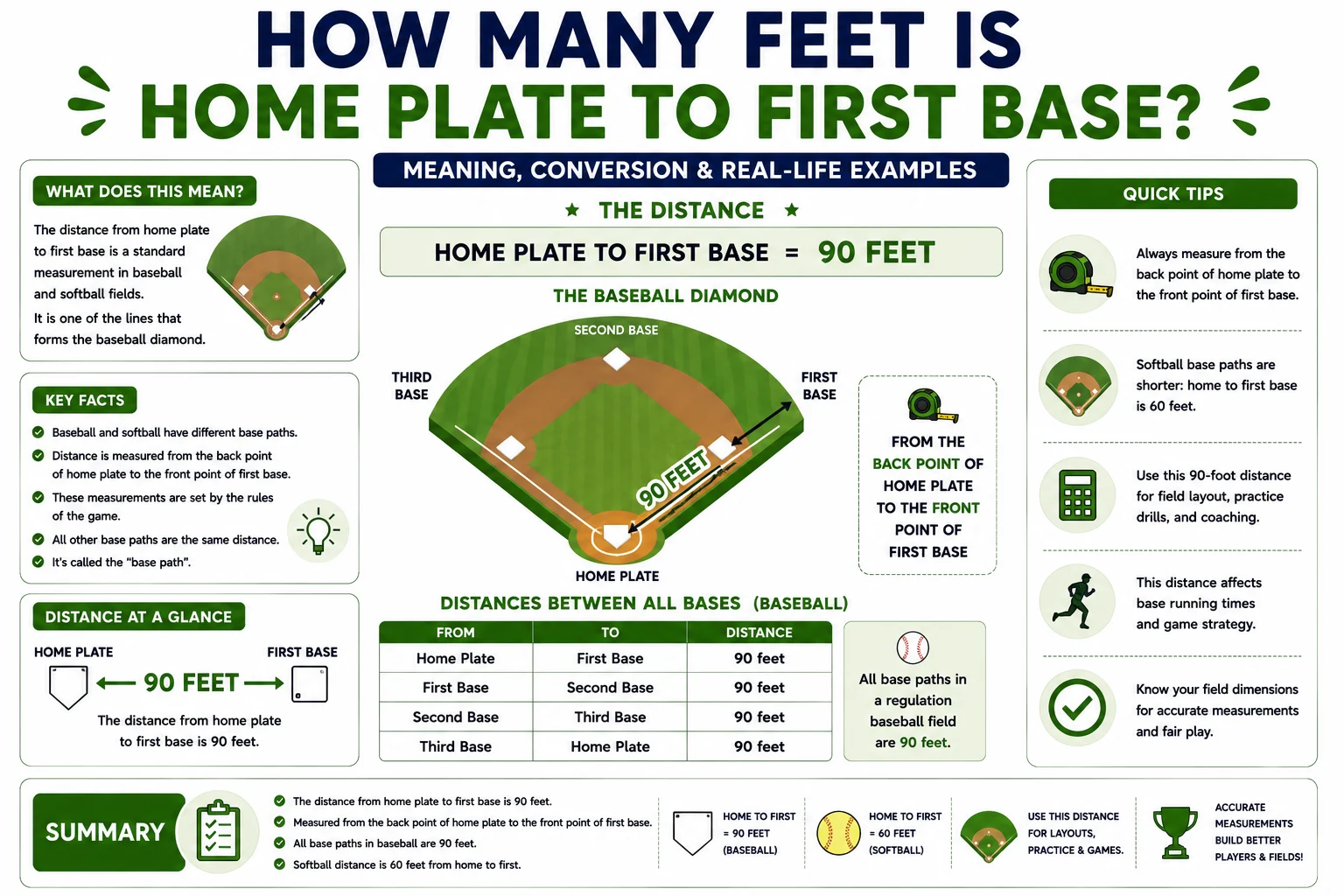
👉 The official distance from home plate to first base is 90 feet in Major League Baseball.
This same distance also applies to:
- Second base
- Third base
- All base paths in professional baseball
Understanding baseball field dimensions helps:
- Players improve performance
- Coaches teach correctly
- Fans better understand the game
- Builders design proper fields
In this complete guide, you’ll learn:
- Official baseball measurements
- Distances between bases
- Little League and softball comparisons
- Field layout explanations
- Interesting baseball facts
Quick Answer: Home Plate to First Base Distance
The official distance is:
90 feet
This measurement is used in:
- Major League Baseball (MLB)
- College baseball
- Most adult leagues
The base path forms a square called the baseball diamond.
Official Baseball Field Measurements
A baseball field follows strict dimensions.
MLB Base Path Dimensions
Each side of the baseball diamond measures:
90 feet
That includes:
- Home plate to first base
- First base to second base
- Second base to third base
- Third base back to home plate
Why Base Distances Matter
The 90-foot distance affects:
- Running speed
- Defensive plays
- Pitching strategy
- Game balance
If the bases were closer or farther apart, the sport would change dramatically.
How Many Feet Is Home Plate to First Base Exactly
The exact measurement is:
90 feet
This distance is measured:
- From the rear point of home plate
- To the back corner of first base
This creates an accurate square layout.
Baseball Diamond Layout Explained
The baseball diamond is actually a square.
Each side measures:
- 90 feet
The four bases are:
- Home plate
- First base
- Second base
- Third base
Together, they form the infield.
Total Distance Around the Bases
A player running a home run travels:
90×4=360
👉 Total distance = 360 feet
Distance Between All Bases
Here’s a quick chart of baseball base distances.
| Base Path | Distance |
|---|---|
| Home to first | 90 ft |
| First to second | 90 ft |
| Second to third | 90 ft |
| Third to home | 90 ft |
Home Plate to First Base in Different Leagues
Not every league uses the same dimensions.
Major League Baseball
Official distance:
- 90 feet
Little League Baseball
Younger players use shorter base paths.
| League | Base Distance |
|---|---|
| Tee Ball | 50–60 ft |
| Little League | 60 ft |
| Intermediate League | 70 ft |
| MLB/College | 90 ft |
High School Baseball
Most high school fields also use:
- 90-foot base paths
Baseball vs Softball Base Distances
Softball fields are smaller than baseball fields.
Fastpitch Softball
Typical base distance:
- 60 feet
Slowpitch Softball
Usually:
- 65 feet
This shorter distance matches:
- Smaller field size
- Different gameplay pace
How Baseball Fields Are Measured
Field builders use precise measurements.
Step 1: Mark Home Plate
Home plate becomes the starting point.
Step 2: Measure 90 Feet
Measure toward first base and third base.
Step 3: Create a Square
All sides must match equally.
Step 4: Install Bases
Bases are placed carefully according to official rules.
Real-Life Examples and Comparisons
Understanding 90 feet becomes easier with comparisons.
Example 1: School Bus Length
A standard school bus is about:
- 35–45 feet long
So home plate to first base is roughly:
- Two bus lengths
Example 2: Basketball Court
A basketball court is:
- 94 feet long
That means the base path is slightly shorter than a basketball court.
Example 3: Sprint Distance
Running to first base requires explosive speed because players cover:
- 90 feet quickly
Professional players often reach first base in:
- About 4 seconds
Common Baseball Field Measurement Mistakes
Measuring From the Wrong Spot
Distances must be measured correctly from:
- Specific plate and base corners
Uneven Base Paths
All sides of the diamond must remain equal.
Incorrect Youth League Dimensions
Different age groups require different measurements.
Why Base Distances Are Important
The 90-foot measurement shapes baseball strategy.
Offensive Impact
Batters must run quickly to beat throws.
Defensive Balance
Fielders need enough reaction time.
Pitching and Hitting Strategy
The distance affects:
- Bunts
- Steals
- Ground balls
- Double plays
Fun Facts About Baseball Field Dimensions
The 90-Foot Rule Has Lasted for Decades
Professional baseball has used 90-foot base paths since the 1800s.
Base Distance Influences Speed
Even small changes would dramatically affect scoring.
Baseball Fields Are Unique
Unlike many sports, baseball field outfields vary in shape and size.
However:
- Base paths stay standardized
Benefits of Understanding Baseball Measurements
Knowing baseball dimensions helps:
- Players improve skills
- Coaches teach correctly
- Fans understand strategy
- Groundskeepers build accurate fields
It also makes watching games more enjoyable.
Conclusion
So, how many feet is home plate to first base?
👉 The official distance is:
90 feet
This measurement forms the foundation of professional baseball and helps create the speed, strategy, and excitement fans love.
Whether you’re:
- Playing baseball
- Coaching youth teams
- Building a field
- Learning the rules
understanding base distances gives you a deeper appreciation for the game.
FAQs
1. How many feet is home plate to first base in MLB?
The official MLB distance is 90 feet.
2. Is every baseball base path 90 feet?
Yes, in professional baseball all base paths are 90 feet.
3. How far is it around all the bases?
A full trip around the bases equals 360 feet.
4. Are Little League bases 90 feet apart?
No, Little League fields usually use shorter distances like 60 feet.
5. Is softball base distance the same as baseball?
No, softball bases are usually closer together than baseball bases.
Find it more
how many square feet are in a yard of fabric